
What does DAS mean in blackjack?
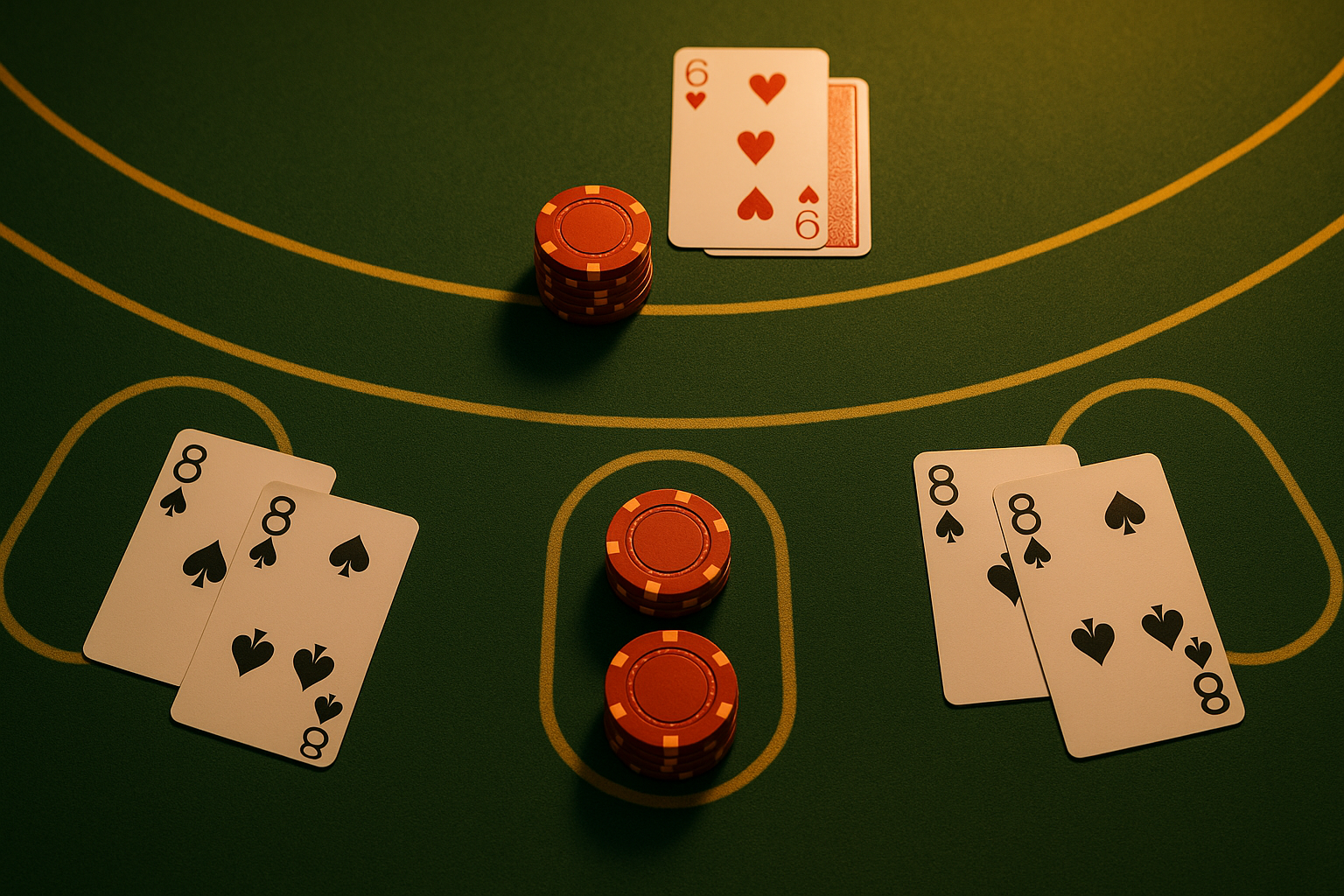
DAS in blackjack stands for Double After Split: the table permits you to double down on a hand you created by splitting a pair. Split 8-8 against a dealer 6, catch a 3 on the first eight for a total of 11, and DAS lets you put out a second bet on that 11. On an NDAS table (No Double After Split), you’d have to hit it and take one card at a time.
That’s the whole rule. It sounds minor, and most players never check it. It is, however, one of the handful of rule variations that measurably shifts the house edge and changes several decisions on your basic strategy chart.
How tables show it varies:
- Land-based tables: the rules are printed on the felt or on a small placard, usually as “Double on any two cards” plus a line like “Doubling after split permitted” or “Double down after split allowed”. If the felt says nothing about splitting and doubling together, ask the dealer before you sit.
- Online and live dealer tables: the rules live behind the “i” or “Game Rules” button in the interface, under a heading like Rules or Payouts. Most mainstream live blackjack allows DAS, but side-bet-heavy variants and some single-hand RNG games restrict it.
One more thing worth knowing early: DAS and re-splitting are separate rules. A table can allow doubling after a split but cap you at one split, or allow three splits but no doubling on split hands. Read both lines.
How DAS affects the house edge
Published blackjack rule-effect tables (the Wizard of Odds rule comparisons are the standard reference) put the value of Double After Split at roughly 0.14 percentage points in the player’s favour in a multi-deck game. So a shoe game that would run a 0.60% house edge under NDAS drops to about 0.46% once DAS is added, assuming you play accurate basic strategy.
Why does it help? Because doubling is the one moment in blackjack where you get to increase your bet after seeing information. Splitting creates two fresh hands, and some of those hands land on the totals where doubling is profitable, 9, 10 and 11, or a soft hand against a weak dealer card. NDAS takes that option away exactly when your hand has the most potential. You still pay for the split; you just can’t press the advantage.
Here’s how DAS ranks against other common rule changes, using the widely published approximate effects for multi-deck games. Positive numbers help the player, negative numbers help the house.
| Rule variation | Approx. effect on house edge | Who it favours |
|---|---|---|
| Double after split (DAS) allowed | +0.14% | Player |
| Late surrender allowed | +0.08% | Player |
| Re-split aces allowed | +0.08% | Player |
| Doubling restricted to 9, 10, 11 | −0.09% | House |
| Dealer hits soft 17 | −0.22% | House |
| Blackjack pays 6:5 instead of 3:2 | −1.39% | House |
The takeaway from that table is one of proportion. DAS is worth having, but a 6:5 blackjack payout costs you about ten times as much as DAS gains you. Chasing DAS while ignoring the payout line is a bad trade.
And the honest framing: even the best shoe rules leave the house with a small mathematical advantage. Correct strategy shrinks the edge, it doesn’t erase it, and over enough hands the house still wins on average.
When to double after splitting: strategy changes
DAS doesn’t touch your hard-total or soft-total decisions at all. It only changes how you play pairs, because a split becomes cheaper to justify when the resulting hands can be doubled. Under DAS you split more often, and more aggressively against weak dealer cards.
The table below shows the standard basic strategy pair decisions for a multi-deck shoe where the dealer stands on soft 17. Single and double deck charts differ slightly, so use a chart matched to your table.
| Your pair | Split with DAS | Split with NDAS | What changes |
|---|---|---|---|
| 2-2 | vs 2 through 7 | vs 4 through 7 | Split vs 2 and 3 instead of hitting |
| 3-3 | vs 2 through 7 | vs 4 through 7 | Split vs 2 and 3 instead of hitting |
| 4-4 | vs 5 and 6 | Never split | Split vs 5 and 6 instead of hitting |
| 6-6 | vs 2 through 6 | vs 3 through 6 | Split vs 2 instead of hitting |
| 7-7 | vs 2 through 7 | vs 2 through 7 | No change |
| 8-8 | Always | Always | No change to the split decision |
| 9-9 | vs 2–6 and 8–9 | vs 2–6 and 8–9 | No change |
| A-A | Always | Always | No change |
Five decisions, that’s it. The 4-4 line is the one that surprises people: a pair of 4s is a hand you normally just hit, but with DAS available against a dealer 5 or 6, splitting into two hands that can each grow into a doubleable total becomes the better play. If you also want a refresher on the awkward 12–16 totals that follow a bad split, our guide to playing stiff hands in blackjack covers those, and the splitting 9s strategy piece handles the pair most players misplay.
Splitting aces with DAS
Here’s the nuance that trips up strategy-aware players: DAS almost never applies to aces. At the large majority of tables, each split ace receives exactly one card and the hand is then closed, so you can’t hit it and you can’t double it. The rule you actually want for aces is re-splitting aces, not DAS.
You split A-A against every dealer card regardless, DAS or NDAS. Two hands starting from a soft 11 beat one hard 12 or soft 2 in every situation, so the decision never flips. If you do find a table that allows hitting and doubling split aces, that’s a genuinely good rule, but treat it as the exception and read the rules panel before assuming it.
Splitting 8s: when DAS matters most
Like aces, 8-8 is always a split, so DAS doesn’t change the decision. What it changes is the money on the table afterwards, and that’s where most of the 0.14% actually comes from in practice.
Take 8-8 against a dealer 6. You split, and each eight is now the base of a live hand. Draw a 3 and you’re on 11 against the dealer’s worst card, the single strongest doubling spot in blackjack. Draw a 2 and you’re on 10, another clear double against a 6. On a DAS table you press both. On an NDAS table you hit those hands one card at a time and leave the extra bet in your pocket.
Same logic against a 5. You split 8s because the dealer is likely to bust, then you want to be able to bet more when your new hand lands on 9, 10 or 11. Losing that option is precisely what the NDAS penalty measures.
Finding DAS tables in India
DAS is common enough that most players will get it by default, but “common” is not “guaranteed”. A quick checklist:
- Open the rules panel first, bet second. On live dealer and RNG blackjack, tap the “i” or Game Rules icon and look for a line about doubling after splitting. It’s usually grouped with the split and double rules, not the payouts.
- Read the whole rule set, not just DAS. Note the number of decks, whether the dealer hits or stands on soft 17, the blackjack payout (3:2 or 6:5), how many splits are allowed, and whether surrender exists. Those together decide the house edge; DAS is one line of it.
- At Goa’s offshore casinos, Sikkim and Daman venues, check the felt. Physical tables print their rules, and dealers will confirm if you ask before the deal. Doubling on split hands is normal at most Indian floors, but table minimums and side-bet rules vary a lot between rooms.
- Be careful with branded variants. Multi-hand, single-deck and “party” style blackjack games often trim rules to pay for a flashy feature or a side bet. If a variant markets a bonus payout, assume something else was tightened until the rules screen tells you otherwise.
- Match your chart to the table. A basic strategy DAS chart is not the same as an NDAS chart. Using a DAS chart on an NDAS table costs you money on 2-2, 3-3, 4-4 and 6-6, and the reverse is just as wrong. Start with a basic blackjack strategy overview and then pick the version that matches the rules in front of you.
Is DAS worth seeking out?
Yes, but keep it in its place. Given two otherwise identical tables, take the DAS one every time, it’s free value. What you should not do is walk past a 3:2, dealer-stands-on-soft-17 shoe to sit at a 6:5 table because that one allows doubling after splits. You’d be trading away roughly 1.39% to gain 0.14%.
A sensible priority order when you’re picking a blackjack table in India, online or live:
- Blackjack pays 3:2, never 6:5. This one is non-negotiable.
- Dealer stands on soft 17 rather than hits.
- Fewer decks, all else equal.
- DAS allowed.
- Late surrender and re-splitting aces, if offered.
- Skip the side bets. Their house edge is typically many times the main game’s.
DAS is the kind of detail that separates players who read the rules from players who just sit down. It’s worth about 0.14% and five changes to how you play pairs, and both of those cost you nothing to pick up. Just remember what the number means: it shrinks the house’s edge, it doesn’t hand you one. Blackjack still has a built-in house advantage, results over a session are dominated by variance, and no rule set or strategy chart changes that. Set a budget before you play, use deposit and session limits, and treat the money as entertainment spend rather than expected return. If it stops being fun, use the cool-off and self-exclusion tools your operator is required to provide.
FAQ
What does DAS mean in blackjack?
DAS means Double After Split, a table rule that lets you double down on hands created by splitting a pair. Its opposite is NDAS, No Double After Split, where split hands can only be hit or stood.
How does DAS affect the house edge?
Published rule-effect figures for multi-deck blackjack put DAS at about 0.14 percentage points in the player’s favour, so a game running roughly 0.60% under NDAS falls to roughly 0.46% with DAS and accurate basic strategy.
Which hands should you double after splitting?
Double any split hand that lands on 9, 10 or 11 against a weak dealer card, per your basic strategy chart, most often after splitting 8s and low pairs against a dealer 4, 5 or 6. DAS also changes whether you split at all with 2-2, 3-3, 4-4 and 6-6.
Is DAS good or bad for the player?
Good. It adds an option without adding an obligation, and every basic strategy chart built for DAS shows a slightly lower house edge than its NDAS equivalent. It’s still a smaller factor than the blackjack payout or the dealer’s soft 17 rule.
Does DAS apply to split aces?
Usually not. Most tables deal one card to each split ace and close the hand, so doubling isn’t possible there. Look for re-split aces instead if you want a better rule for pairs of aces.