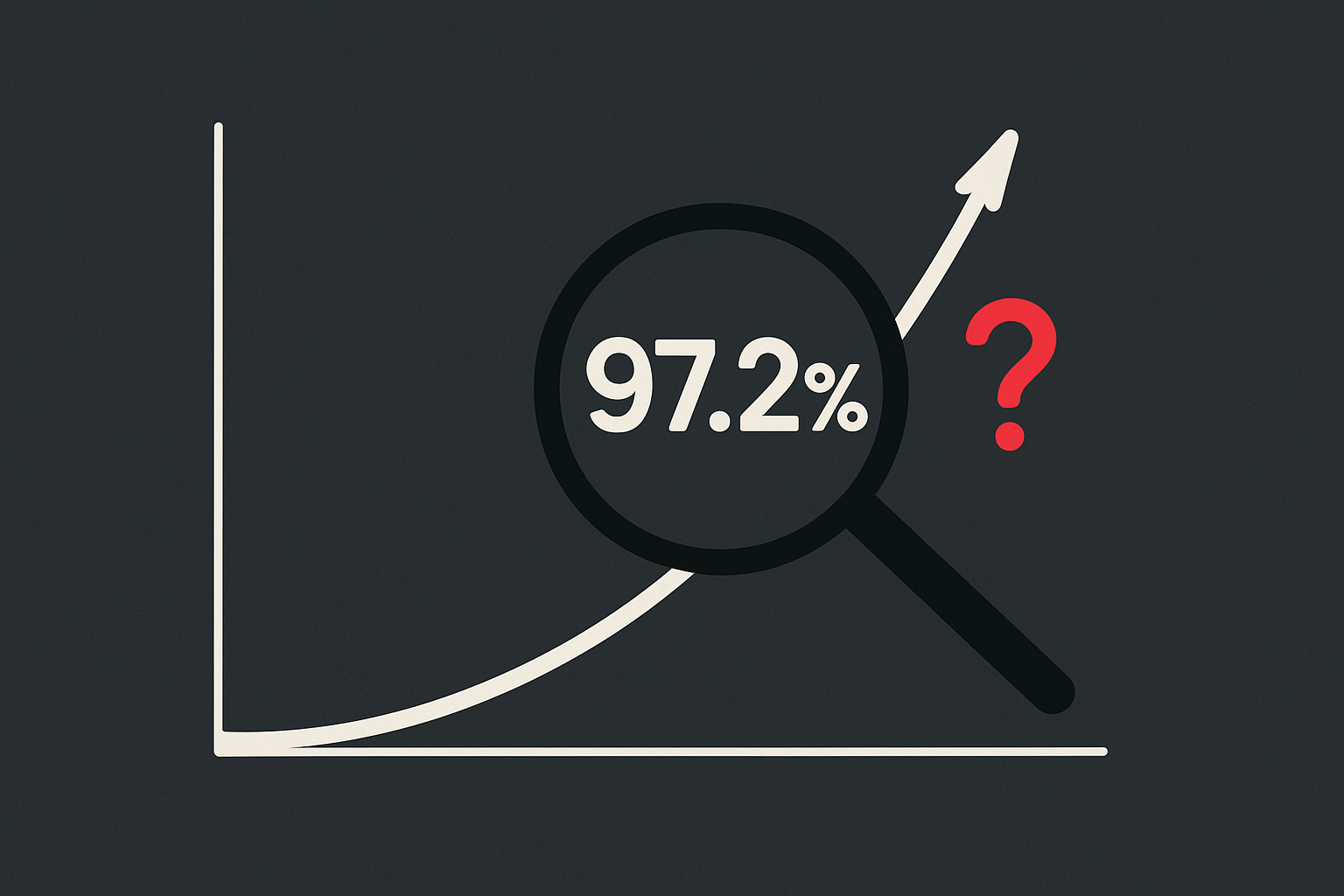
The short answer: no, Aviator doesn’t have a 97.2% “win rate”
When an affiliate banner or a casino promo tells you Aviator has a “97.2% win rate,” it’s misusing a number. That figure is the game’s RTP (return to player) — the theoretical share of all money wagered that the game pays back across millions of rounds. It is not the percentage of rounds you win. The Aviator win rate you personally experience depends almost entirely on where you set your cash-out, and it can be anywhere from under 1% of rounds to close to 90%.
Here’s the difference in one line. A 97% RTP means that for every ₹100 wagered across the whole player base over the long run, roughly ₹97 comes back as payouts and about ₹3 stays with the operator. If it actually meant you won 97 rounds out of 100, no casino on earth would host the game.
Aviator, made by Spribe, publishes an RTP in the 97% region, and that’s the number marketing teams grab and relabel. Whatever the exact decimal on the version you’re playing, the label “win rate” is wrong.
What does RTP mean? (And why it’s not a win rate)
RTP is the long-run average percentage of total stakes a game returns as winnings, calculated over an enormous number of rounds — typically millions of simulated or recorded outcomes. It’s a property of the game’s maths, not a forecast for your next 20 rounds or your evening.
Simple example. You bet ₹100 a round, 1,000 rounds. That’s ₹100,000 wagered. At 97% RTP, the mathematically expected return across that volume is ₹97,000, meaning an expected loss of about ₹3,000. Your real result will land above or below that, sometimes a long way off, because outcomes come from a random number generator and every round is independent of the last. But the expectation never flips positive.
RTP vs house edge: two sides of the same coin
House edge is simply 100% minus RTP. At 97% RTP the house edge is 3%. That 3% is the built-in mathematical advantage that makes the game profitable for the operator over time, and it applies no matter which cash-out strategy you use. Auto cash-out at 1.05×, manual cash-out at 50×, alternating between them — the edge stays. For the deeper arithmetic on how that 3% is baked into the multiplier distribution, see our breakdown of the Aviator house edge and RTP.
Why “long-term” matters more than you think
“Long term” in RTP terms is not 500 rounds. It’s the pooled activity of every player, over months, in volumes an individual will never come close to matching. Over a few hundred rounds, variance dominates completely. You can finish a session up 300% or down to zero at a 97% RTP game, and both results are entirely normal.
This is where the marketing gets slippery. A high RTP is a genuine plus when you’re comparing games, but it’s a statement about the game’s design, not a safety net for your session.
Aviator’s real win frequency vs its 97.2% RTP
Your win frequency in Aviator is something you set, not something the game gives you. Crash games with a constant house edge are built so that the chance of the multiplier reaching a given value x is roughly the RTP divided by x. With a 97% RTP, that means the probability of surviving to 2.00× is about 0.97 ÷ 2 = 48.5%, and the probability of reaching 10× is about 9.7%.
The table below applies that model. Treat the percentages as the design maths for a crash game at 97% RTP rather than a guarantee about any specific round — outcomes are generated by an RNG, and the exact distribution belongs to the provider (Spribe publishes the game’s RTP and provably fair verification method in the in-game info panel).
| Auto cash-out target | Approx. chance the round reaches it | Return when it hits (₹100 stake) | Long-run expected return |
|---|---|---|---|
| 1.10× | ~88% | ₹110 | ~97% |
| 1.50× | ~65% | ₹150 | ~97% |
| 2.00× | ~48.5% | ₹200 | ~97% |
| 5.00× | ~19.4% | ₹500 | ~97% |
| 10.00× | ~9.7% | ₹1,000 | ~97% |
| 100.00× | ~1% | ₹10,000 | ~97% |
What your actual win rate looks like
Cash out at 1.10× and you’ll win the large majority of rounds — but each win adds only 10% to your stake, and the losses wipe out the full stake. Chase 100× and you’ll lose roughly 99 rounds in 100. Neither approach changes the expected return; both sit at about 97% of what you wager. The only thing you’re choosing is the shape of the ride.
So if someone shows you a screenshot claiming a 97% “win rate,” ask them at what multiplier. The honest answer would be somewhere near 1.00×, which pays nothing.
Why high RTP doesn’t mean frequent wins
RTP and volatility are separate things. Volatility describes how the returns are distributed — Aviator is a high volatility game at the multipliers most players actually target, because a small number of large multipliers carry a big chunk of the total payout. Two games can both return 97% while one pays small amounts constantly and the other pays rarely and heavily. Raising RTP doesn’t make wins more frequent; it just reduces the operator’s cut.
Why casinos use “win rate” in their marketing
Because “97.2% win rate” reads as “you’ll win nearly every round,” and “97.2% RTP” doesn’t. It’s a deliberate blur between a regulatory term and a promotional one.
Licensed game providers and regulators use precise language: return to player, theoretical payout, house edge. Those terms are audited and testable. Marketing copy, especially from affiliate sites and unregulated brands, often swaps in “win rate,” “payout rate” or “winning chance” because they sound like personal odds rather than a pooled long-term average. The number stays technically real; the meaning gets swapped out.
You’ll see the same trick in the reverse direction — a game’s RTP quoted without mentioning that the operator can sometimes select a lower RTP configuration, or a bonus advertised on headline value with the wagering requirement buried. The pattern to spot is a true figure attached to a false label.
How to read casino marketing claims critically
The rule I use: if a claim tells you how often you’ll win, it’s a claim no honest game can make. Every real number in this space describes averages or probabilities, and every real probability depends on what you’re betting on.
Where to find accurate RTP information
- The in-game info or “i” panel. Providers state RTP there, and crash games usually explain their provably fair system, including how to verify a round with server and client seeds.
- The provider’s own game page rather than the casino’s landing page.
- The casino’s game rules or help section, which sometimes discloses that a game runs at a specific RTP version.
- Independent game databases and regulator publications for cross-checking. If two sources disagree, trust the in-game panel for the version you’re actually playing.
Questions to ask before you play
- Is this number an RTP or a claim about how often I win? If the page says “win rate,” treat it as a red flag about the whole page.
- What’s the house edge? 97% RTP means 3%. Say it out loud in edge terms and the marketing shine drops off fast.
- How volatile is it at my target multiplier? A 10× target loses about nine rounds in ten by design.
- Does the site show a licence, and does the in-game RTP match what the promo claims?
- Are there guarantees, “sure win” signals, or predictor apps involved? Outcomes come from an RNG, so nothing can predict them. Paid predictors are a scam, full stop.
FAQ
Does Aviator have a 97.2% win rate?
No. Figures in the 97% range refer to Aviator’s RTP, the theoretical long-term return on total wagers. Your actual win frequency depends on your cash-out target and is far lower than 97% at any multiplier worth cashing out for.
Is RTP the same as win rate?
No. RTP is the share of all stakes returned as payouts over millions of rounds. Win rate is how often a round ends in a win. A game can return 97% while you win fewer than one round in ten.
What does 97% RTP actually mean over time?
Across ₹100,000 in total wagers, the expected return is about ₹97,000, an expected loss of ₹3,000. Short sessions swing widely around that figure in both directions, but the 3% house edge never disappears.
Play with the real numbers in mind
A 97% RTP game is still a game with a negative expected return, and Aviator’s swings are sharp enough that a losing run of 10 or 20 rounds at a 2× target is unremarkable. Set a deposit limit, decide your stake and session length before you open the game, and use the cool-off or self-exclusion tools your operator provides. If it stops being entertainment, stop playing and reach out to a support service. Our responsible gambling guide lists the tools and helplines available to players in India. Gambling is for adults only (18+).