Craps almost certainly got its name from dice slang that travelled with the game across the Atlantic. The two leading explanations: the Louisiana French word crapaud, meaning toad, describing players crouched over a pavement game, and the older English term “crabs”, which was what gamblers called the losing throw of two ones in the dice game hazard. Somewhere in 19th century New Orleans, “crabs” became “craps”, and the name stuck.
That’s the short answer to why is it called craps. Below, the longer version, plus a plain-English primer on how the game actually works, written for readers who grew up with Teen Patti and Andar Bahar rather than Vegas dice tables.
Why is the game called ‘craps’? The name’s origins
Craps descends from hazard, an English dice game that was popular for centuries before anyone in America rolled a bone. In hazard, a throw of two (snake eyes) lost immediately, and English players nicknamed that roll “crabs”. Some etymologists trace the word straight from there: crabs, then craps.
The competing theory points to French. In Louisiana French, crapaud means toad, and the story goes that the game’s early street players hunched over the ground like squatting toads. Because New Orleans was where the game took root in America, and because both English and French were spoken there, the two theories aren’t really in conflict. One word may well have shaped the other.
The figure usually credited with bringing the game from Europe to Louisiana in the early 1800s is Bernard de Marigny, a wealthy Creole gambler from New Orleans. The version he imported was rougher than modern craps: players could only bet with the shooter, which left the game open to abuse by anyone willing to slip in loaded dice. Craps history took a decisive turn in the early 20th century when American dice maker John H. Winn added the “don’t pass” bet, letting players wager against the shooter too. That single change made cheating far less profitable and turned craps into the table game you’d recognise today.
What is craps? Game basics for beginners
Craps is a dice game played with two six-sided dice, where players bet on the outcome of a roll or a series of rolls. Only two dice, only 36 possible combinations, and yet the table looks like an engineering diagram. Ignore that for now. The mechanics underneath are simpler than the felt suggests.
The role of the shooter
One player, the shooter, throws the dice. Everyone at the table bets on the results of those throws, including the shooter. In a land-based casino the dice pass clockwise around the table, so each player gets a turn shooting, and you can always decline and keep betting instead.
Important point that confuses newcomers: you are not playing against the shooter, and the shooter is not playing against you. The house books every bet. A good roll pays most of the table at once, which is where craps gets its reputation as the loudest game on the casino floor. In online craps, either a live dealer throws the dice on camera or a random number generator produces the result, so there’s no shooter rotation to worry about.
Come out roll vs point phase
A craps round has two possible phases.
- Come out roll. The first throw of a new round. A 7 or 11 is an instant win for pass line bettors. A 2, 3 or 12 is “craps” and an instant loss. Any other total (4, 5, 6, 8, 9, 10) becomes the point number.
- Point phase. The dealer marks the point with a puck, and the shooter keeps rolling. If the point number comes up again before a 7, pass line bets win. If a 7 arrives first, they lose. That’s it, no other number matters for that bet.
Here’s how the come out roll breaks down across the 36 possible dice combinations:
| Come out result | Combinations (of 36) | Chance | Pass line outcome |
|---|---|---|---|
| 7 or 11 | 8 | 22.2% | Win immediately |
| 2, 3 or 12 | 4 | 11.1% | Lose immediately |
| 4, 5, 6, 8, 9 or 10 | 24 | 66.7% | Becomes the point |
Understanding the craps table layout
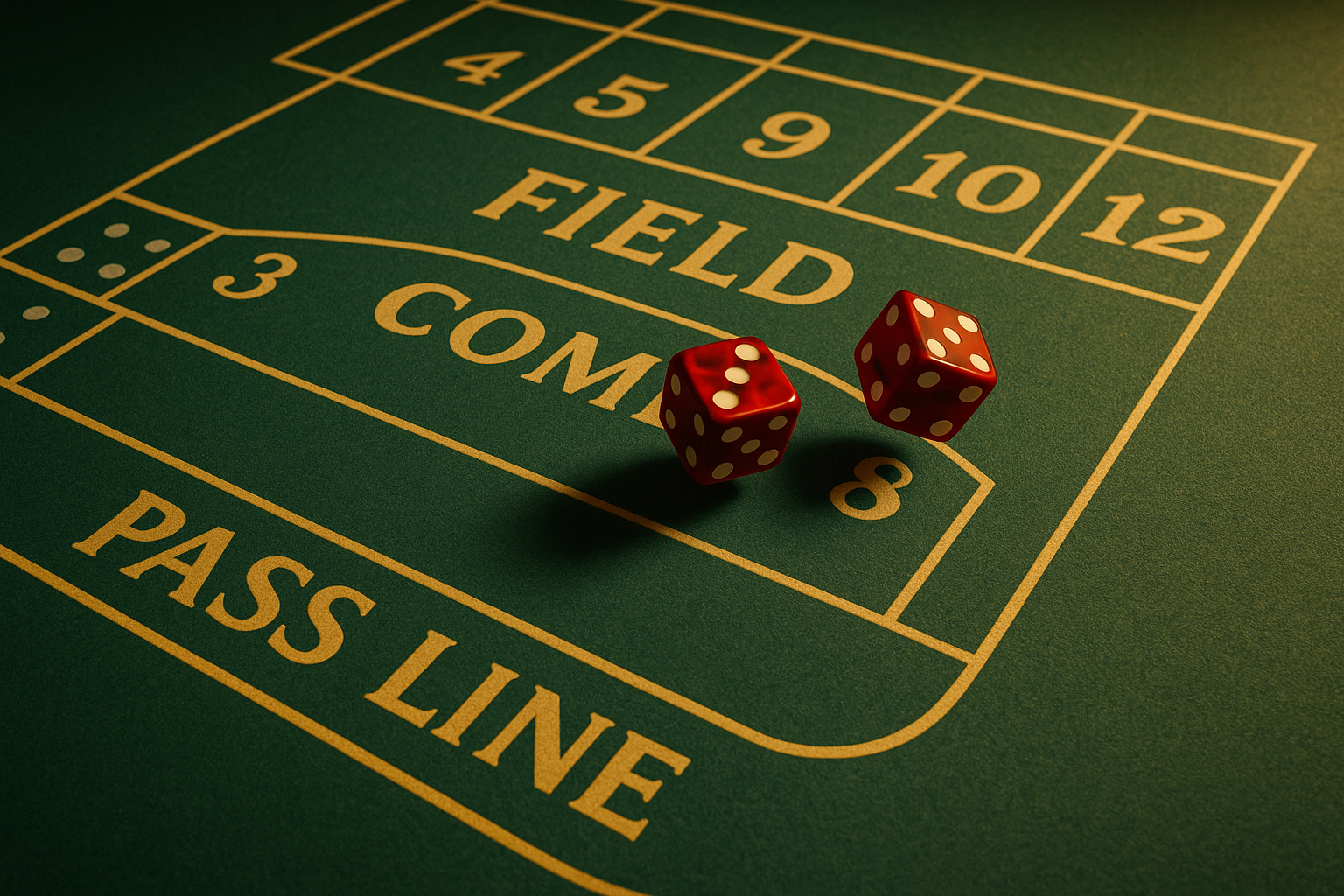
A craps table is a long, sunken oval with an identical set of betting areas at each end, so two dealers can serve both halves of the table. Learning craps table basics means learning about four areas and cheerfully ignoring the rest until you’re comfortable.
- Pass line. The long band running around the outside edge. This is where most players bet, and where beginners should start.
- Don’t pass bar. Sits just inside the pass line. It’s the opposite wager: you win when pass line bets lose, with one twist (a 12 on the come out is usually a push, not a win).
- Field. The wide strip marked 2, 3, 4, 9, 10, 11, 12. A one-roll bet that looks friendly and isn’t, mathematically speaking.
- Place numbers. The boxes labelled 4, 5, 6, 8, 9, 10 along the top. You’re betting a specific number appears before the next 7.
The middle of the table, crowded with pictures of dice and words like “hardway”, “any seven” and “horn”, is the proposition betting area. It’s run by the stickman and it carries by far the worst odds on the table. Every craps guide worth reading tells beginners to avoid it, and this one does too.
How to play craps: the pass line bet
The pass line bet is the entire game for most casual players, and it’s the cheapest bet in the house in terms of the edge you concede. Here’s how to play craps using it, step by step:
- Place your chips on the pass line before the come out roll.
- The shooter throws. Roll a 7 or 11 and your bet pays even money (1:1) straight away.
- Roll 2, 3 or 12 and the bet loses. New round begins.
- Any other total becomes the point. The dealer places the puck on that number.
- The shooter keeps rolling. Your bet wins at even money if the point repeats before a 7, and loses if the 7 comes first.
Once a point is established, the odds of your bet winning depend on which number it is, because some totals are easier to roll than others. A 6 or 8 can be made five ways; a 4 or 10 only three.
| Point number | Ways to roll it | Chance of hitting it before a 7 |
|---|---|---|
| 6 or 8 | 5 | 45.5% |
| 5 or 9 | 4 | 40.0% |
| 4 or 10 | 3 | 33.3% |
Pass line betting strategy
The honest version of pass line strategy is short: bet the pass line, skip the centre of the table, and if you want a little more action, back your point with the “odds” bet the dealer will happily explain. Free odds is the one wager in the casino paid at true mathematical odds, so it carries no house edge of its own, though the money you put behind the line is still money at risk on a coin-flip-ish outcome.
What no strategy does is change the dice. Each roll is independent, the same way each spin of a slot is independent under its RNG. A shooter who has made four points in a row is not “hot” in any predictive sense, and a table that has been cold is not owed a run.
House edge on basic bets
The pass line carries a house edge of about 1.41%, meaning that over a long run of bets the house keeps roughly ₹1.41 of every ₹100 wagered. Don’t pass is slightly lower at about 1.36%. Compare that with the tempting-looking bets in the middle of the felt and the difference is stark.
| Bet | Approx. house edge | Beginner verdict |
|---|---|---|
| Pass line | 1.41% | Best starting point |
| Don’t pass | 1.36% | Fine, but you’re betting against the table mood |
| Free odds (behind the line) | 0% | Only bet paid at true odds |
| Place 6 or 8 | 1.52% | Reasonable |
| Field (2:1 on both 2 and 12) | 5.56% | Skip |
| Any 7 | 16.67% | Avoid |
A 1.41% edge is low compared with most casino games, but it is still an edge, and it never switches off. Over enough rolls, the house wins. That’s the design, not bad luck.
Is craps beginner-friendly for Indian players?
Yes on the maths, no on the first impression. If you only ever place a pass line bet, craps is easier to learn than blackjack and gives you better odds than roulette, where European single-zero wheels carry a 2.7% house edge. The rules that matter fit in a paragraph.
The barrier is the environment. A live craps table is fast, loud, run by three or four staff using their own vocabulary, and covered in bets you’re being encouraged to make. Craps is also uncommon in India. Casinos in Goa, Sikkim and Daman build their floors around Teen Patti, Andar Bahar, roulette, blackjack and baccarat, so most Indian players meet craps for the first time online.
That’s actually the gentler introduction. Online craps, whether live dealer or RNG based, lets you take your time, tap the pass line, and watch a few rounds without a stickman waiting on you. If you’ve played Andar Bahar, the underlying feeling is familiar: a simple binary call, resolved quickly, with the house holding a small mathematical cut. Craps just wraps that idea in a much busier table.
A quick reality check before you try it: craps is entertainment with a built-in cost, not a way to make money. Decide your budget before you sit down, use deposit and session limits where your casino offers them, and stop when the money you set aside is gone. If gambling stops feeling like a game, take a break and use the self-exclusion tools available to you. Our responsible gambling guide covers the tools worth setting up first, and if you’re new to table games generally, start with our casino basics for beginners.
FAQ
Why is the game called craps?
The name most likely comes from “crabs”, the English nickname for the losing two-dice roll in the older game hazard, and possibly from Louisiana French crapaud (toad), describing crouching street players. Both theories point to New Orleans in the 1800s.
What are the basic craps rules?
A shooter rolls two dice. On the come out roll, 7 or 11 wins for pass line bettors and 2, 3 or 12 loses. Any other number becomes the point, and the shooter keeps rolling until either the point repeats (pass wins) or a 7 appears (pass loses).
What is the pass line bet?
The pass line bet is a wager that the shooter “passes”, winning on a come out 7 or 11, or by repeating the point before rolling a 7. It pays even money and has a house edge of about 1.41%.
Is craps beginner-friendly?
The core bet is very beginner-friendly; the table and the pace are not. Learn the pass line, ignore the proposition bets in the middle, and practise online before trying a live table.