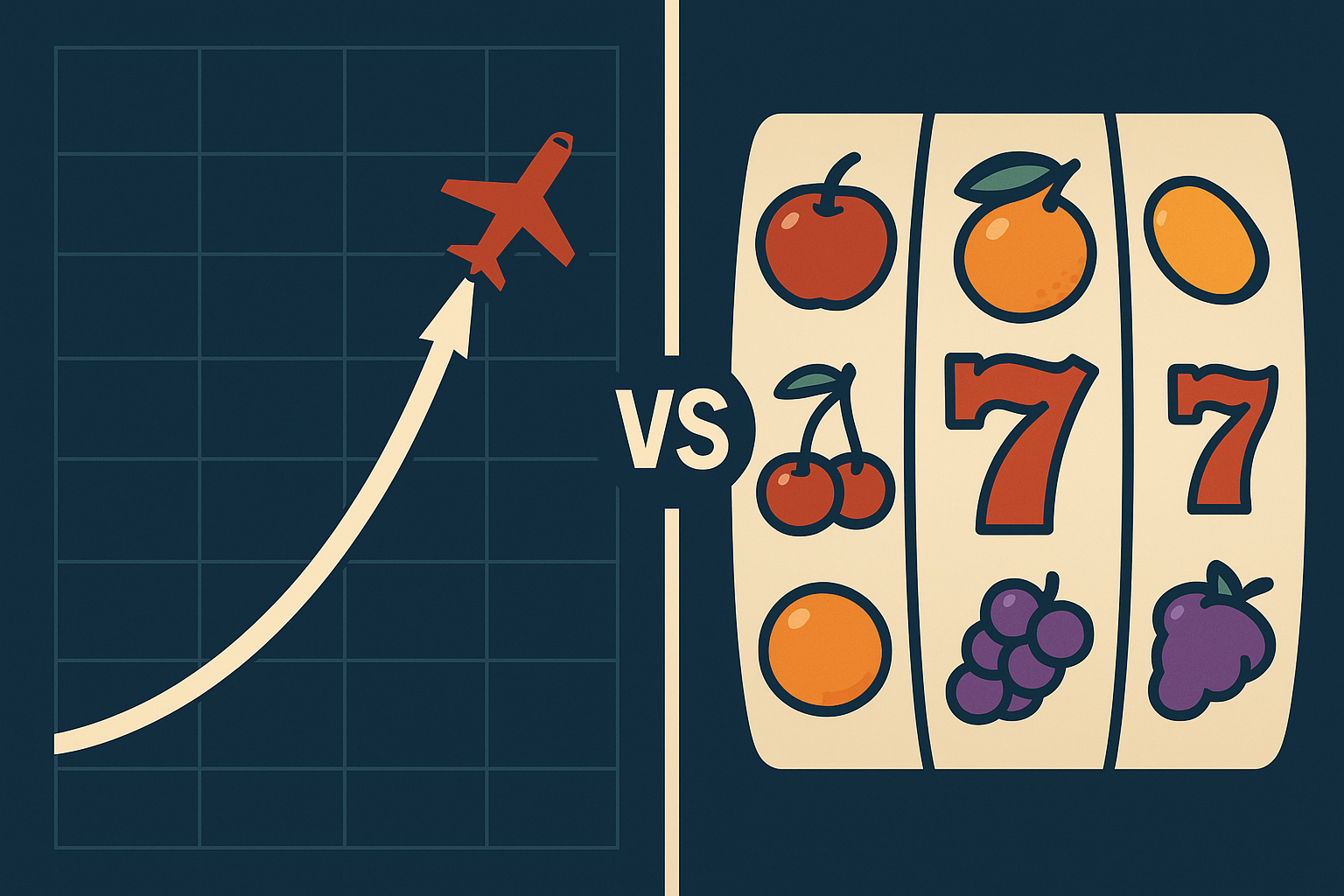
What’s the difference: provably fair vs RNG certification
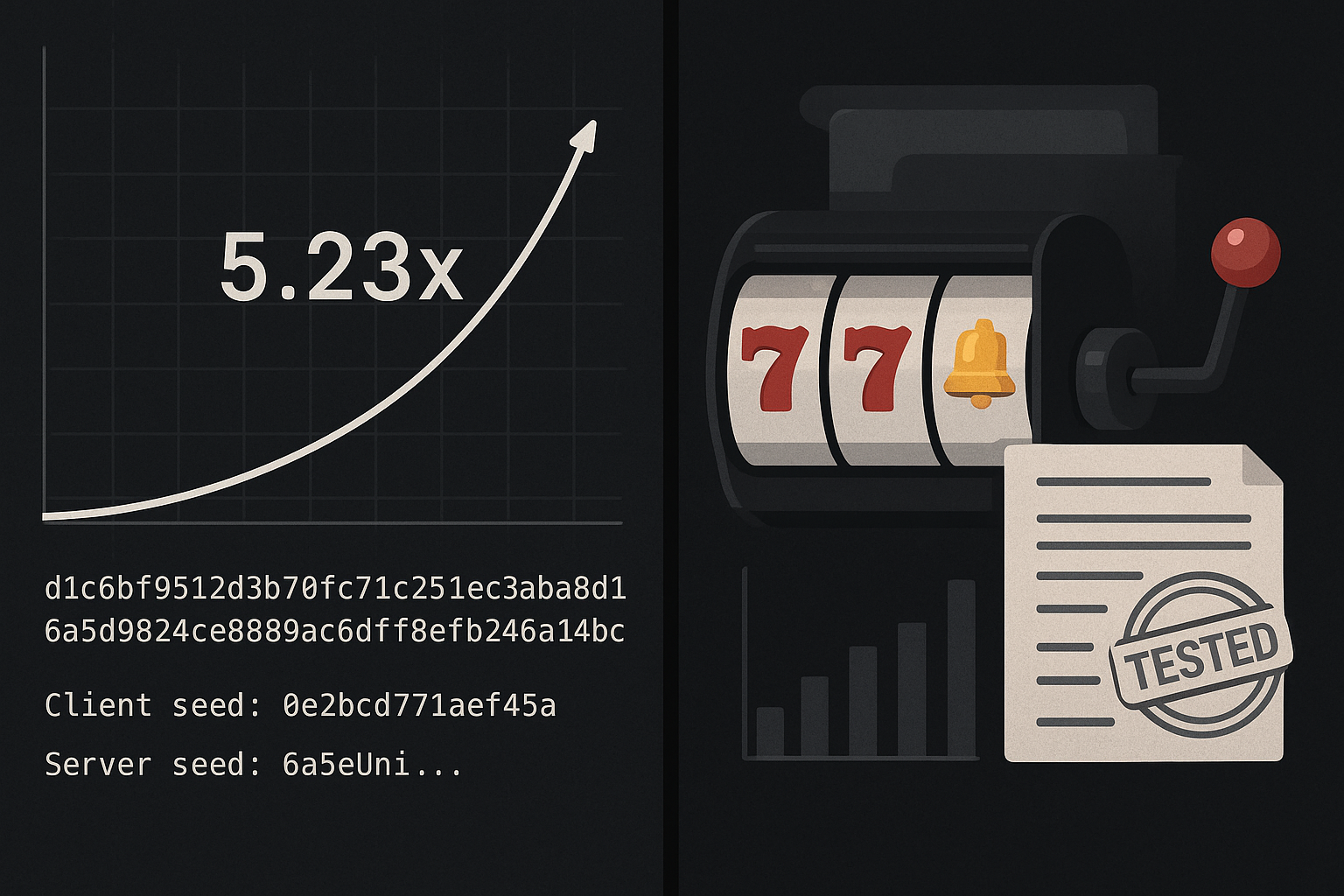
The short answer: provably fair vs RNG certification is the difference between checking a single round yourself, right now, and trusting an independent lab that tested the game months ago. Provably fair systems use cryptography, usually a SHA-256 hash, to let you confirm that the outcome of your round was fixed before you placed the bet. RNG certification means a third-party testing lab examined the game’s random number generator and payout maths, then issued a certificate.
Both answer the same question, “was this outcome rigged?”, from opposite directions. Provably fair gives you per-round proof but tells you nothing about the game’s long-run return. Lab certification verifies the maths and the RTP but gives you no way to audit your own spin. Neither one proves you will win anything, and neither removes the house edge.
How provably fair works (crash games method)
Provably fair crash games generate the crash point from a combination of inputs before the round starts, then publish enough information afterwards for you to reconstruct it.
The standard setup uses three ingredients:
- Server seed – a secret random string created by the game server. Before the round, the site shows you only its hash, not the seed itself.
- Client seed – a value contributed by the player, or in multiplayer crash rounds, often derived from the bet IDs of everyone in the round. On many sites you can edit your client seed manually.
- Nonce – a counter that increments each round, so the same seed pair produces a different result every time.
The server combines these with a hash function and converts the output into a multiplier. Once the round ends, the server seed is revealed. You hash it and compare the result to the hash you were shown earlier. If they match, the seed existed before you bet, which means the server could not have swapped it after seeing your stake or your cash-out timing.
Some implementations go further and seed rounds from a public blockchain block hash, so the input is verifiable by anyone and not chosen by the operator at all. Cryptography researchers describe hash commitments exactly this way: you commit to a value publicly without revealing it, then prove later that you never changed it. [Editor: attach a reference on cryptographic commitment schemes here.]
What you can verify yourself
You can verify three specific things, and they are worth knowing precisely:
- The server seed was decided before betting closed (the hash matches).
- Your client seed was actually used in the calculation.
- The published multiplier is what the seeds and nonce mathematically produce.
Most crash titles, including Aviator-style games, keep this under a “Fairness” or “Provably Fair” tab in the round history. Independent verifier pages also exist, which matters, because checking the maths on the operator’s own tool is a slightly circular exercise. If you are new to the format, our guide to how Aviator rounds work covers the mechanics before the cryptography.
Limitations of provably fair
This is where a lot of marketing overstates things. Provably fair proves the round was not tampered with. It does not prove the game is generous, or even that it is well designed.
- It says nothing about the house edge. A crash game typically builds its edge into the crash-point distribution, often through a small chance the round busts instantly at 1.00×. Verifying a hash won’t reveal that distribution.
- Verifying one round proves one round. Confirming that the multiplier distribution matches what the operator advertises takes thousands of rounds and statistical testing, which is exactly what a lab does.
- If the operator supplies both the server seed and the client seed and you never change yours, you are trusting more of the process than you might think.
- Almost nobody actually checks. A verification tool that sits unused provides psychological comfort, not oversight.
- It has nothing to say about withdrawals, bonus terms, or whether the site pays out at all.
How RNG lab certification works (slots method)
Slots and table games take the trust problem to an independent laboratory instead. A studio submits the game build to a testing lab, which examines the random number generator and the game maths, then issues a certificate the operator and regulator can point to.
Testing usually covers four areas: the statistical randomness of the RNG output, the mapping of RNG output onto game symbols and outcomes, the theoretical RTP against the paytable, and whether the software behaves as its rules describe. Labs run large simulated samples, millions of rounds, and apply standard statistical tests for uniform distribution and for correlation between consecutive outputs. They also typically fingerprint the approved build, so a regulator can check that the game running live is the same one that passed.
Who tests casino RNGs
A handful of accredited labs do most of this work for licensed operators and game studios:
- GLI (Gaming Laboratories International) – widely used for RNG and game testing across many regulated markets.
- iTech Labs – Australian lab well known for RNG evaluations and RTP verification.
- eCOGRA – tests games and also audits operators; eCOGRA certification has historically included published payout percentage reporting for some operators.
- BMM Testlabs – another long-established testing lab used by regulators and suppliers.
How often retesting happens depends on the licensing regulator, not the lab. New games and significant maths changes need fresh testing. Ongoing operator-level audits, where someone compares actual payouts against theoretical RTP over a period, are a separate service and not something every site buys.
What lab certification proves
Certification tells you that the RNG output passed randomness tests, that outcomes are independent of previous spins, and that the game’s theoretical RTP matches what the paytable and info screen claim. That last point is the useful one for players, because it is the number that describes the long-run house edge: a slot with 96% RTP has a 4% house edge, averaged over millions of spins and never guaranteed for your session. Our explainer on how slot RTP actually works goes into why session results scatter so far from that figure.
What it does not prove: that the certificate is current, that the operator is running the certified build, or anything about your individual spin. Certificates can also be old, or displayed by sites that never earned them.
Which games use which system
The split follows game complexity and who wrote the software.
| Game type | Usual fairness system | Why it fits |
|---|---|---|
| Crash games (Aviator style) | Provably fair, plus lab testing where the licence requires it | One random output per round, easy to commit to and reveal |
| Slots from major studios | RNG lab certification | Many random draws per spin, proprietary reel strips and paytables |
| Dice, plinko, mines (crypto originals) | Provably fair | Simple, single-outcome maths built in-house |
| RNG table games (roulette, blackjack) | RNG lab certification | Card and wheel outcomes come from a certified RNG |
| Live dealer games | Physical fairness plus studio audits and licensing | Real cards and wheels, so there is no RNG to hash |
Why slots can’t be provably fair
Strictly speaking, some can. Several crypto casinos run in-house “original” slots with provably fair verification. But a modern studio slot is a much harder fit, for practical reasons rather than mystical ones.
A single spin may pull dozens of random values: reel positions, cascade refills, wild placement, multiplier values, bonus wheel selections. To verify the outcome yourself you would need the full mathematical model, including weighted reel strips and feature tables. That model is the studio’s commercial property, and publishing it would also let players work out precisely how often features trigger. So the industry outsources the check to a lab that signs an NDA, sees the maths, and confirms the RTP.
Hybrid approaches
The two systems are not mutually exclusive, and the better crash games use both. A provably fair game distributed to licensed operators still goes through RNG testing, because the regulator wants an independent view of the crash-point distribution and the stated RTP. That combination is stronger than either alone: the lab checks the maths model, the hash lets you check that your specific round used it honestly.
How to verify game fairness as a player
Practical steps, in the order I would actually do them:
- Check the licence first. Fairness tooling on an unlicensed site is decoration. Find the regulator name and licence number in the footer and confirm it on the regulator’s own website.
- For crash games, run one verification. Open the round history, find the Fairness tab, copy the server seed, hash, client seed and nonce, and check them in a third-party verifier rather than only the site’s own tool. Change your client seed once to confirm the field is live.
- For slots, read the info panel. The RTP should be stated in the game rules. If two versions of the same slot exist at different RTPs, the panel is where you find out which one you are playing.
- Click the lab logo, don’t just look at it. A genuine eCOGRA, iTech Labs or GLI badge should lead to a certificate or verification page on the lab’s domain. A logo that links nowhere is a red flag.
- Watch for missing basics. No published RTP, no game rules screen, no licence, no fairness tab: that is your answer.
Which system should you trust more?
Neither, exclusively. They cover different gaps, and the honest comparison looks like this.
| Aspect | Provably fair | RNG lab certification |
|---|---|---|
| What it proves | This round was not altered after your bet | The RNG is statistically random and the RTP matches the paytable |
| Who checks | You, per round | An accredited lab, per game build |
| Timing | Real time | Before release, plus retests when required |
| Covers house edge? | No | Yes, as theoretical RTP |
| Main weakness | Says nothing about the maths model or payouts | You cannot audit your own spin, and certificates can be stale or faked |
Provably fair is the stronger tool against one specific abuse: an operator changing an outcome once it sees your stake. Lab certification is the stronger tool for the thing that actually decides your long-term results, which is the game’s return and the house edge behind it. A crash game with a verified hash and a 5% edge will still cost you more over time than a certified slot at 96% RTP.
So the useful position is not picking a winner. It is knowing what your evidence covers. If you play crash games, verify a round occasionally and treat the hash as proof of process, not of value. If you play slots, read the RTP and check that the certification badge leads somewhere real. In both cases, the fairness system tells you the game is behaving as designed, and the design always favours the house.
FAQ
What is the difference between provably fair and RNG certification?
Provably fair lets a player cryptographically verify an individual round in real time using a server seed, client seed and nonce. RNG certification is an independent lab’s verdict on the game’s randomness and RTP, issued before release. One is per-round proof, the other is per-game assurance.
Who tests casino RNGs?
Accredited testing laboratories such as GLI, iTech Labs, eCOGRA and BMM Testlabs, usually because a licensing regulator requires it before a game can go live.
Can slots be provably fair?
Simple in-house slots at some crypto casinos are. Mainstream studio slots generally are not, because a spin uses many random values and verification would require publishing the confidential reel and feature maths.
Gambling involves risk and every game keeps a mathematical edge for the house. Play only with money you can afford to lose, use deposit and session limits, and take a break or self-exclude if it stops being entertainment. 18+ only.