The short answer: a fixed jackpot pays a set prize that never changes, and you’ll hit it far more often; a progressive jackpot pools contributions from many players into a prize that can reach crores, but the odds of landing it are brutal. Choosing between a fixed vs progressive jackpot slot comes down to whether you want frequent, modest top prizes or a very small chance at a life-changing one, and how much bankroll you can afford to spend finding out.
Fixed vs progressive jackpots: the key differences
There are really only two families in the types of slot jackpots you’ll see in an Indian-facing casino lobby.
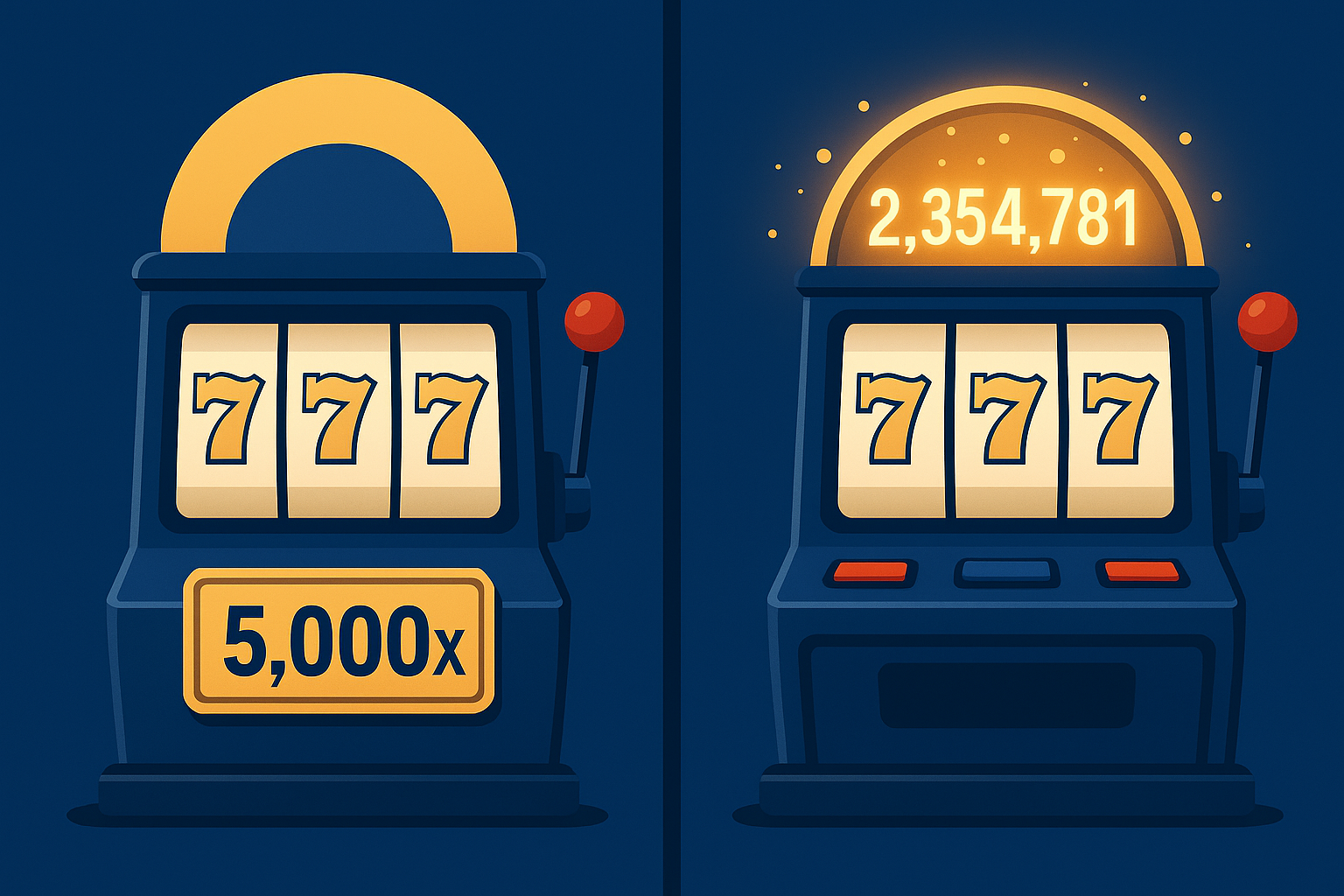
A fixed jackpot (sometimes called a static or flat jackpot) is a top prize written into the paytable, usually expressed as a multiple of your stake. Land five wilds on a payline and you win, say, 5,000× your bet. Nothing funds it beyond the game’s normal maths, so nothing about it grows. Bet ₹10 and the top prize is 5,000 × ₹10 = ₹50,000. Bet ₹100 and the same combination pays ₹5,00,000. The prize scales with your stake, not with time.
A progressive jackpot works differently. A slice of every qualifying bet, the contribution rate, is skimmed off and added to a shared pot. That pot starts at a seed amount (the guaranteed minimum the provider resets it to after a win) and climbs until somebody triggers it. Contribution rates are typically small, often in the region of 1% to 3% of each bet, but multiplied across thousands of players the pot grows fast.
Progressives come in a few flavours worth knowing:
- Standalone: fed only by that one machine or game. Smallest pots, best odds of the three.
- Local (in-house): pooled across one casino’s players.
- Network (wide area): pooled across every casino running the provider’s game, in multiple countries. These are the ones that produce the headline multi-crore wins.
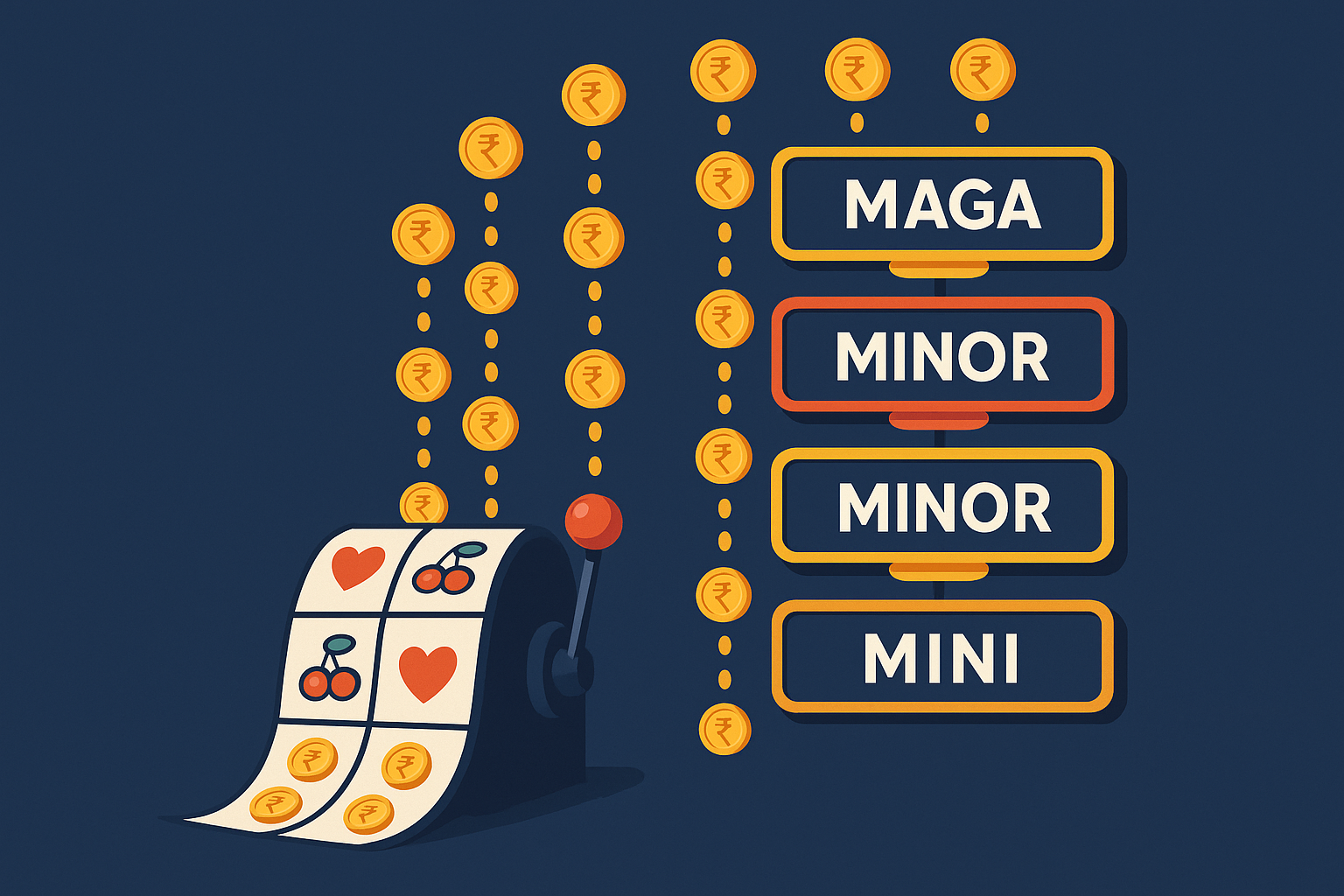
- Must-drop / daily drop: a progressive with a hard ceiling or time limit, so it must pay out before a set amount or by a set hour. Smaller prizes, much shorter waits.
The trade-off is simple to state and easy to underestimate: fixed jackpots give you a known, capped prize you can realistically hit; progressives give you an uncapped prize you probably won’t. If you’re new to how the pooling works, our explainer on what a progressive jackpot is covers the plumbing in more detail.
Jackpot odds: which type is easier to win?
Fixed jackpots are easier to win, and not by a small margin. The gap is usually several orders of magnitude.
Fixed jackpot win rates
A fixed top prize is just another paytable outcome. Its probability is baked into the reel maths, and on a typical high volatility slot the top combination might come up somewhere in the range of once every few hundred thousand spins to once every few million, depending on the game. On lower volatility fixed jackpot slots with modest top prizes (a few hundred times stake), the top hit can be far more frequent than that.
Providers rarely publish the exact probability of the top symbol combination, but you can read it indirectly: the smaller the maximum win relative to stake, the more often it lands. A 500× top prize hits far more often than a 10,000× one. That’s the maths doing its job, not luck.
Progressive jackpot probability
Progressive jackpot odds are long because the prize is huge and the game still has to balance. Widely played network progressives are commonly quoted with jackpot odds in the tens of millions to one per spin. Some providers publish these figures in the game’s help file or info screen, and it’s worth opening it before you commit a bankroll.
Two things players get wrong here. First, on many progressives you only qualify for the top tier if you bet at or above a minimum stake, or if you activate all lines, so betting small can mean playing with a house edge but no shot at the pot. Second, a rising jackpot does not mean it’s “due”. Every spin is an independent RNG event. A pot that hasn’t dropped in four months is no more likely to drop on your next spin than it was on day one.
RTP impact: how jackpot type affects your returns
That contribution rate has to come from somewhere, and it comes out of the base game. This is the single most overlooked point in the fixed vs progressive comparison.
Fixed jackpot slots typically publish RTP in the usual 94% to 97% band, and essentially all of that return flows back through regular wins and features you have a realistic chance of hitting. Progressive slots often report two numbers: a base game RTP and a total RTP that includes the jackpot contribution. Some classic network progressives list base game RTP in the high 80s, with total RTP climbing towards the mid 90s once the jackpot share is counted.
Here’s why that matters. The jackpot portion of RTP is real, but it’s concentrated in an outcome you will almost certainly never see. So your practical return, the money you actually get back over a few thousand spins, tracks the base RTP much more closely than the headline figure. If the base game returns 88%, you are losing about ₹12 per ₹100 wagered in the part of the game you can actually reach, while ₹8 or so sits in a pot for someone else. Either way the house keeps its edge; the difference is where the money is parked.
| Feature | Fixed jackpot | Progressive jackpot |
|---|---|---|
| Prize size | Fixed multiple of stake (often hundreds to a few thousand ×) | Grows continuously, can reach crores on network games |
| Funding | Built into the game’s paytable maths | Seed amount plus a contribution rate from every qualifying bet |
| Typical published RTP | Usually 94–97%, nearly all reachable | Base RTP often lower; total RTP includes the jackpot share |
| Top prize odds | Long, but achievable within a big spin sample | Very long, commonly quoted in the tens of millions to one |
| Minimum bet to qualify | None beyond normal play | Often a minimum stake or max lines required |
| Bankroll needed | Moderate | Large, or accept that the jackpot is a lottery ticket |
Volatility and bankroll considerations
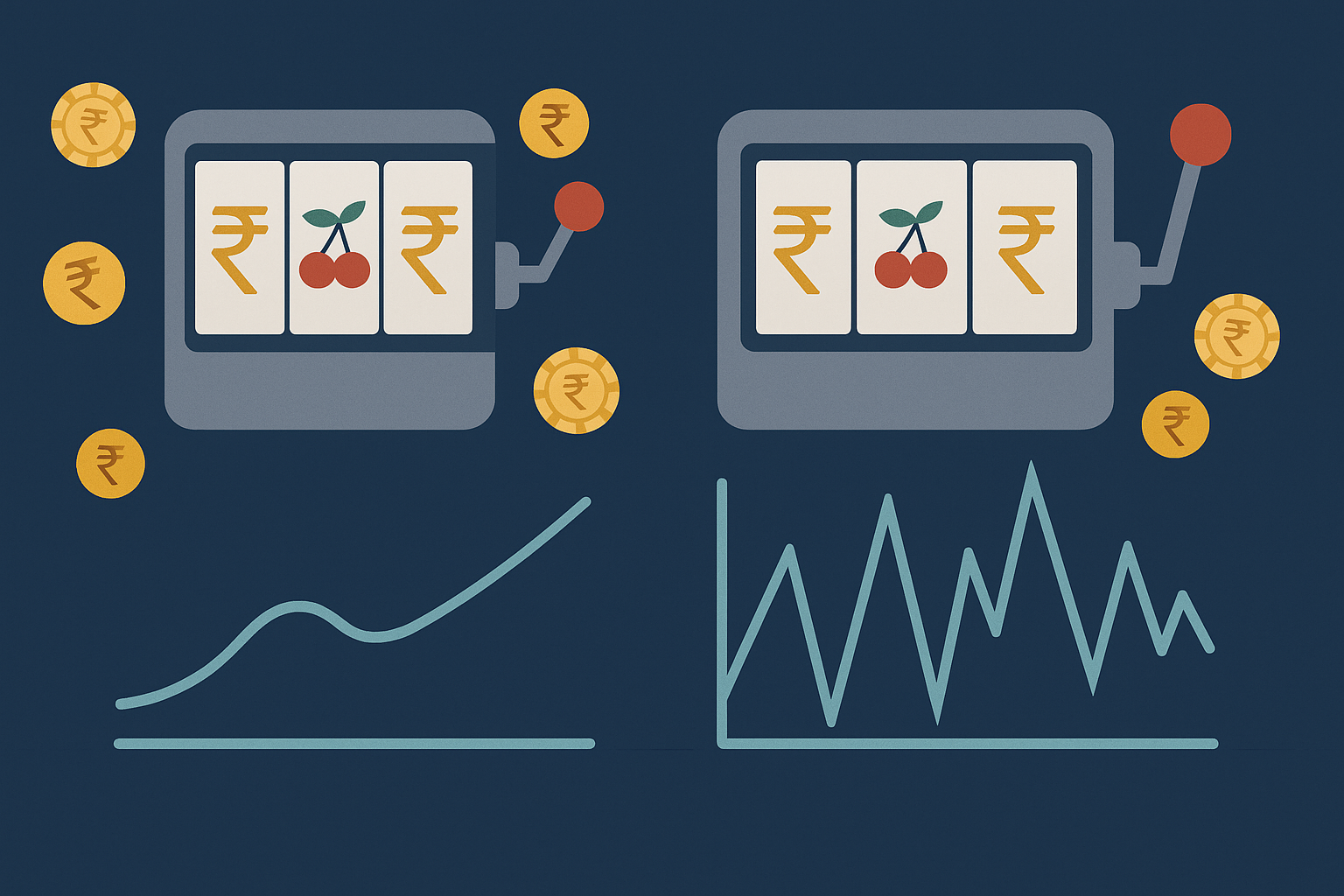
Jackpot volatility is about how your balance behaves between wins, and the two types feel completely different to play.
Fixed jackpot volatility profile
Fixed jackpot games span the full volatility range. A low volatility fixed jackpot slot with decent hit frequency will hand you small wins regularly and keep a ₹2,000 bankroll alive for a long session at ₹10 stakes. A high volatility one with a 5,000× top prize will chew through the same amount quickly during dry spells. The useful part is that the paytable tells you exactly what you’re chasing, so you can size your stake against it. If the top prize is 2,000× and you’re betting ₹20, you know the ceiling is ₹40,000, and you can decide whether that’s worth the variance.
Progressive jackpot session requirements
Progressives are structurally high variance, even when the base game looks tame. The reason is that a meaningful chunk of the theoretical return is locked in the jackpot tier, which means the day-to-day, spin-to-spin experience returns less than a comparable non-progressive slot. Longer losing runs are normal, not bad luck.
Practical bankroll management for progressives:
- Decide your total session budget before you open the game, and treat it as spent money.
- Check the minimum qualifying bet. If it’s higher than your normal stake, the game may simply not fit your bankroll.
- Keep stakes small enough that your budget covers a few hundred spins, not thirty.
- Consider must-drop or daily drop progressives if you want jackpot mechanics with a shorter realistic horizon.
- Set a loss limit and a time limit in your account tools, and stop when you hit either.
If volatility and hit frequency are still fuzzy concepts for you, read our RTP and volatility explainer first. It’ll change how you read a paytable.
Which jackpot type suits your playing style?
Neither type is better. They solve different problems. Match the game to what you actually want out of a session.
| Player profile | Better fit | Why |
|---|---|---|
| Small bankroll (₹1,000–₹3,000), wants a long session | Fixed, lower volatility | Higher practical RTP and better hit frequency stretch the budget |
| Wants a realistic shot at a meaningful win | Fixed, high volatility | Top prize of a few thousand × stake is genuinely reachable |
| Playing a bonus with wagering requirements | Fixed | Steadier returns clear playthrough more predictably; check max bet rules |
| Treats a small stake as entertainment, dreams big | Network progressive | Accepts near-zero jackpot odds in exchange for the size of the prize |
| Wants jackpot excitement without an endless wait | Must-drop / daily drop progressive | Capped pot means it pays out on a defined schedule |
| Focused on best long-run return per rupee | Fixed with high published RTP | None of the RTP is locked away in an unreachable tier |
My own view, having spent plenty of time on both: play progressives the way you’d buy a lottery ticket. A small fixed amount, occasionally, purely for the thrill of watching the counter. Do your regular slot play on fixed jackpot games with published RTP you can check, because that’s where the money you get back actually lives. The reasons progressives dominate marketing are the same reasons they’re expensive to chase, something we look at in more depth in our piece on what makes jackpots so popular.
One caution that matters more with jackpots than any other slot category: a growing pot is designed to feel like it owes you something. It doesn’t. Chasing a progressive with money you can’t afford to lose is the fastest route to a problem. Set deposit and loss limits, use cool-off or self-exclusion tools if play stops being fun, and never treat a jackpot as a plan for anything. The house edge applies to every spin, on both jackpot types, whatever the counter says.
Frequently asked questions
What is the difference between fixed and progressive jackpots?
A fixed jackpot is a set prize written into the paytable, usually a multiple of your stake, and it never changes. A progressive jackpot grows from a seed amount as a percentage of every qualifying bet is added to a shared pool, until one player triggers it and it resets.
Are progressive jackpots harder to win?
Yes, substantially. Network progressive jackpot odds are commonly quoted in the tens of millions to one per spin, while a fixed top prize sits in the hundreds of thousands to a few million range depending on the game. Standalone and must-drop progressives fall somewhere in between.
Which jackpot type has better odds?
Fixed jackpots, clearly. They also tend to return more of the RTP through outcomes you can realistically hit, which makes your practical return higher over a normal session.
Do progressive slots have lower base RTP?
Usually, yes. The contribution rate that feeds the jackpot pool is taken out of the base game, so the base RTP is often several percentage points lower than a comparable non-progressive slot. The total RTP including the jackpot tier can look competitive, but that portion is only paid to whoever wins the pot.