Slot volatility explained: what variance actually means
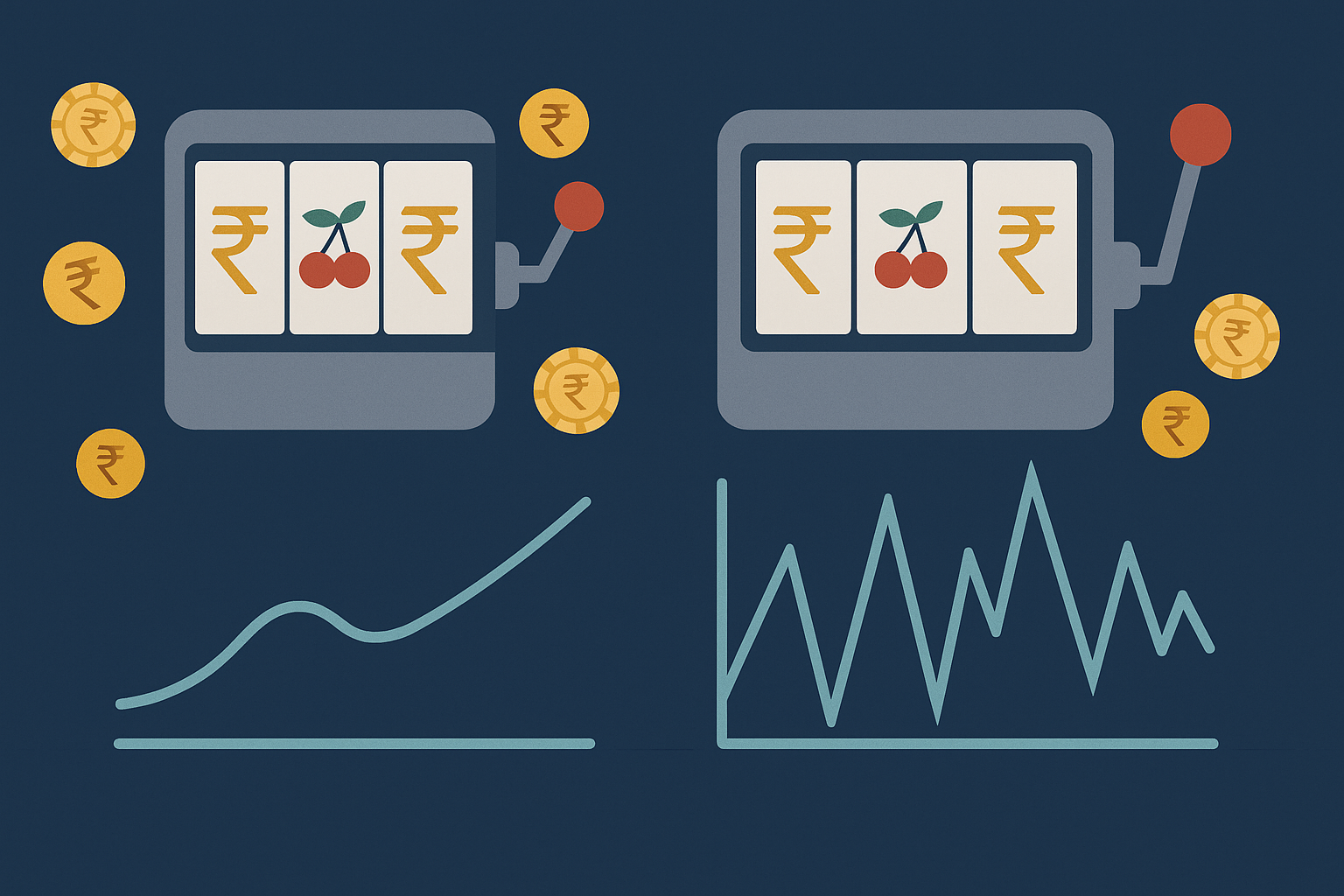
Slot volatility (also called variance) describes how a game’s payouts are distributed: how often you win and how big those wins tend to be. Low volatility slots pay small amounts often. High volatility slots pay rarely, but when they do land, the payouts can be many times your stake. That’s the whole idea in one sentence.
A simple way to picture it: two people each walk 100 steps to the same destination. One takes 100 even steps. The other stands still for 90 steps, then covers the distance in ten huge leaps. Same distance, completely different journey. Volatility is the journey, not the destination.
Here’s the part beginners miss. Volatility says nothing about how much a game returns in total. That’s RTP. Two slots can both return 96% over millions of spins while feeling nothing alike: one drips small wins every third spin, the other goes dead for 80 spins and then pays 150× in a bonus round. Volatility is the shape of the ride, RTP is the long-run average, and the 4% difference between 96% RTP and 100% is the house edge that never goes away.
Low vs medium vs high volatility slots: the differences
The three levels differ in hit frequency (how often any win lands), the size of typical wins, and how much bankroll you need to sit through the dry spells. The figures below are typical ranges you’ll see across commercial slots, not fixed rules for any single game.
| Trait | Low volatility | Medium volatility | High volatility |
|---|---|---|---|
| Typical hit frequency | Roughly 30–45% of spins | Roughly 25–30% of spins | Often 20–25% of spins or less |
| Usual win size | Below 1× to about 5× stake | A few × stake, occasional 20–50× | Mostly small or nothing, rare 100×+ |
| Where the return comes from | Base game line wins | Mix of base game and features | Heavily from free spins / bonus rounds |
| Session feel | Steady, slow drift | Moderate ups and downs | Long dead stretches, sharp spikes |
| Bankroll needed per spin size | Smallest | Moderate | Largest |
| Risk of losing the whole session bankroll fast | Lower | Medium | Highest |
Low volatility slots: frequent small wins
These games hand back something on a large share of spins, often less than your stake. A ₹20 spin that returns ₹8 registers as a “win” on screen with lights and sound, but you’re still ₹12 down. Classic fruit machines and simple three reel games usually sit here. The appeal is playing time: your balance erodes slowly, so a modest deposit stretches a long way.
Medium volatility slots: balanced risk-reward
Most popular video slots land in the middle. You get enough base game wins to stay in the game, plus free spin rounds that can pay 20× to 50× your stake without being once-a-month events. If you don’t know what you want yet, medium variance is the sensible default while you learn how a game behaves.
High volatility slots: rare big payouts
High variance games park most of their return inside features that trigger infrequently. Megaways titles, games with big multiplier mechanics and progressive jackpot slots typically fall here. Expect stretches of 50, 100 or more spins with nothing meaningful. Expect them, plan for them, and understand that the size of the possible payout is exactly why the dry spells are so long. Nothing is free: the maths has to balance.
How is volatility different from RTP?
RTP is the percentage of all wagers a game returns over the long run, averaged across millions of rounds. Volatility is how unevenly that return arrives. RTP answers “how much comes back on average?” Volatility answers “in what pattern, and how bumpy will it be?”
Take two slots at 96% RTP, both played at ₹20 a spin for 500 spins. Total wagered is ₹10,000 and the expected loss is 4% of that, or ₹400, on both games. But the low variance slot might see you finish somewhere in a narrow band around ₹9,600 returned, while the high variance one could easily leave you with ₹2,000 back, or occasionally ₹25,000, from the same ₹10,000 wagered. Same average, wildly different spread. Statisticians call that spread standard deviation.
Two practical consequences. First, a high RTP does not make a game “safe” if the variance is brutal. Second, no volatility setting changes expected value: every spin on every slot carries a negative expected value for the player because of the house edge. Volatility only changes how the loss is likely to be distributed over your session.
How does volatility affect your bankroll?
Session length and spin count
Divide bankroll by stake and you get your absolute worst case spin count. A ₹2,000 bankroll at ₹20 a spin buys 100 spins if literally nothing comes back. In practice returns extend that. On a low variance slot, small frequent wins recycle your balance and 300 or more spins from ₹2,000 is realistic. On a high variance slot, the same ₹2,000 can vanish in 100 spins with barely a flicker, or it can survive far longer if a feature hits early. The uncertainty itself is the point.
This is why stake sizing matters more than game choice. A common rule of thumb among regular players is to keep each spin at 0.5% to 1% of the session bankroll for medium variance, and lower for high variance. At ₹2,000 that means ₹10 to ₹20 spins, and closer to ₹5 to ₹10 if you’re chasing a big bonus round on a swingy game.
Bankroll swings and risk of ruin
Risk of ruin is the chance you lose your entire session bankroll before you stop. With the same ₹2,000 and ₹20 spins, that risk climbs sharply as variance rises, because high variance games make long losing runs normal rather than unlucky. On a game hitting 22% of spins, a run of 20 blank spins is unremarkable, and runs of 40 or 50 happen regularly across a session.
Two honest points to sit with. Each spin is decided by an RNG and is independent of the last, so a long dry run does not make a payout “due”. And raising your stake after losses shortens your session and increases the chance you bust before any feature triggers. Decide your stake and your stop point before you spin, not while you’re behind. If you want a deeper walkthrough of stake sizing, our bankroll management guide for slot players covers it in detail.
Choosing the right volatility for your play style
Small bankroll: why low volatility makes sense
If you’re depositing ₹500 to ₹1,000 and want an hour of play, low or low-medium variance with small stakes is the rational pick. Higher hit frequency slots recycle your balance so you actually get to play the game you paid for. Putting ₹1,000 into a high variance Megaways title at ₹50 a spin gives you 20 spins in the worst case, which is not a session, it’s a coin flip.
Entertainment vs big win hunting
Be clear with yourself about the goal. If the goal is time at the reels, low variance delivers it. If the goal is the small chance of a large multiplier and you accept that most sessions will end at zero, high variance is the honest tool for that job, played at stakes small enough that busting doesn’t matter to you. What no volatility level does is turn a negative expectation into a positive one. Over time, the house edge wins; treat every deposit as the cost of entertainment, not an investment.
Session time vs payout potential
You are trading one for the other. Same bankroll, same RTP: choose more spins with smaller peaks, or fewer effective spins with a bigger tail. A workable compromise many players use is splitting a session, spending most of the bankroll on a medium variance slot and setting aside a smaller portion for a high variance game at reduced stakes. Set a loss limit and a time limit before you start, and use the deposit limits and reality checks your casino offers. If gambling stops feeling like entertainment, use the cool-off or self-exclusion tools.
Finding volatility information for slots
Where to look, in order of reliability:
- The game’s info screen. Many providers now print a volatility rating (often a 1–5 scale or a low/medium/high label) alongside RTP and max win in the paytable or help pages.
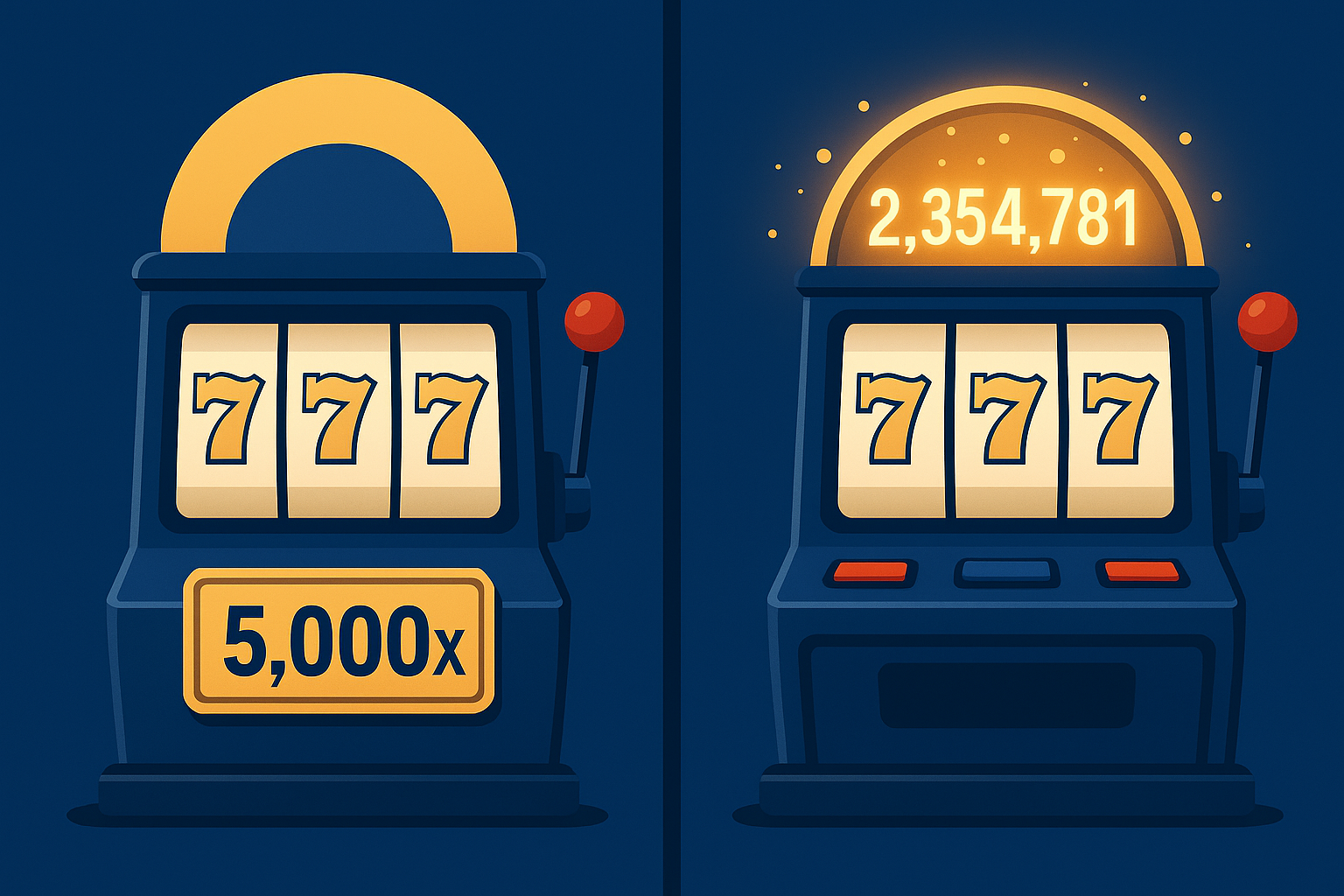
- Max win multiplier. A stated max win of 500× usually signals lower variance; 10,000× or more almost always means high variance, because that ceiling has to be funded by long stretches of nothing.
- Paytable structure. Big gaps between the top symbol payout and the low symbols, plus a return concentrated in free spins with multipliers, point to high variance. Flat, modest line pays point to low.
- Demo mode. Play 200 to 300 free spins and count roughly how many produce any win, and how often features trigger. That won’t give you a precise hit frequency, but the difference between a game hitting one spin in three and one in five is obvious quickly.
- Provider documentation and review sites. Some studios publish maths sheets with hit frequency and volatility figures; reputable review sites list them too. Cross-check rather than trusting a single source.
Whichever games you shortlist, the casino matters as much as the slot: check licensing, withdrawal times and whether RTP and volatility are disclosed at all. Our roundup of the best online casinos for slot players and the guide on how to find slot machines worth playing are useful next steps.
FAQ
What does slot volatility mean?
It means how a slot distributes its payouts: how frequently wins land and how large they typically are. Low volatility means frequent small wins, high volatility means infrequent but larger wins. It does not change the game’s long-run return.
Is high or low volatility better?
Neither is better on average, because both carry the same house edge. Low volatility suits smaller bankrolls and longer sessions; high volatility suits players who accept frequent losing sessions in exchange for a small chance of a large multiplier.
How is volatility different from RTP?
RTP is the average percentage returned over the very long run, such as 96%. Volatility is how unevenly that return arrives spin to spin. Two 96% RTP slots can have completely different variance.
How does volatility affect bankroll?
Higher volatility means bigger swings and a higher chance of losing your session bankroll before a feature triggers, so it needs smaller stakes relative to your balance. Lower volatility recycles your balance more steadily and stretches playing time.
Gambling should only ever be entertainment you can afford to lose. Set deposit and loss limits, take breaks, and seek support if it stops being fun. 18+ only.