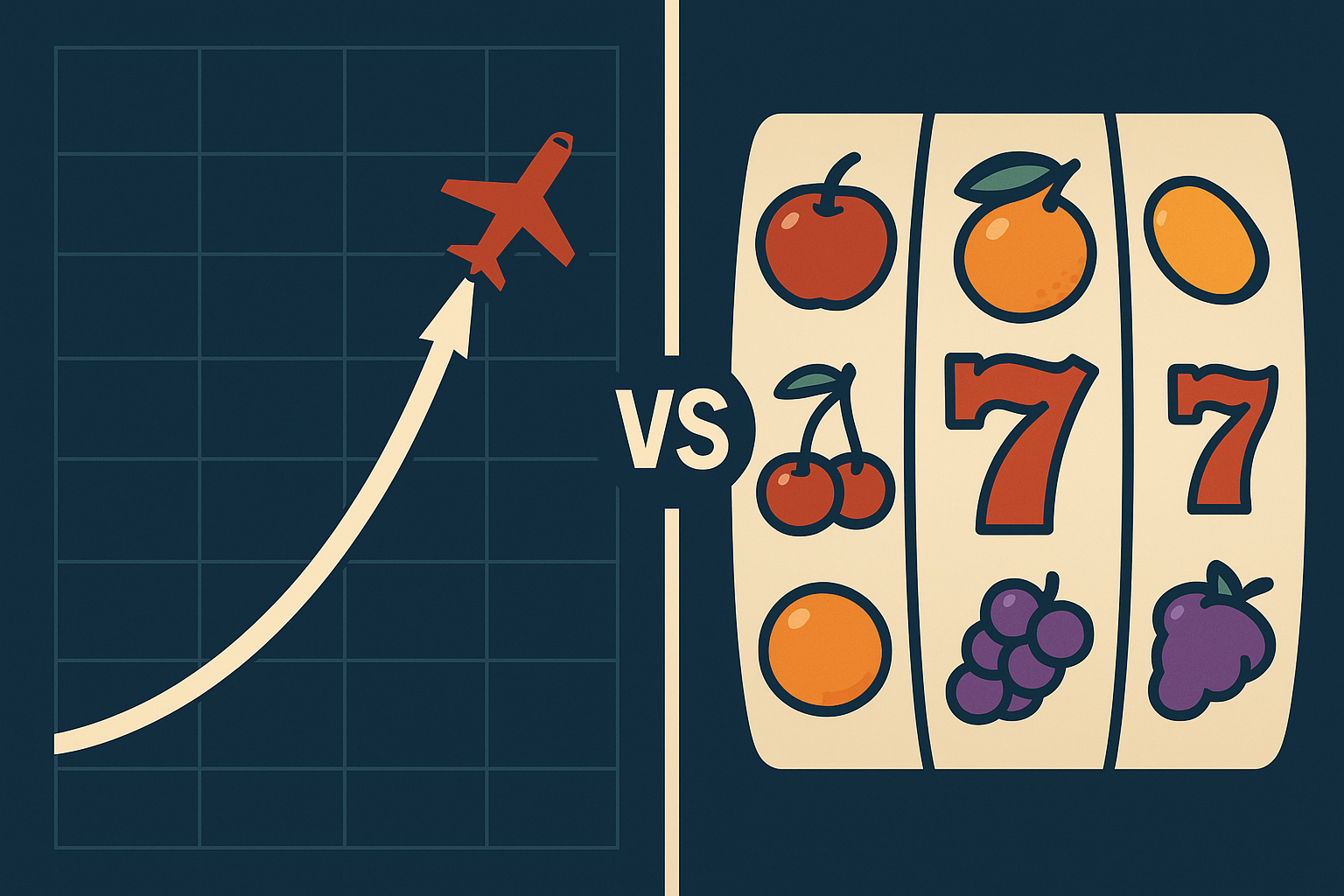
The short answer: pick Aviator if you want a hand on the exit button and a single, fast decision every round. Pick slots if you’d rather press one button and let the game’s features do the work. In the Aviator vs slots debate, the real split isn’t which one “pays more” — the published RTPs are close — it’s how much control you want and how much swing your bankroll can absorb.
Here’s how the two compare on mechanics, RTP, control, and volatility, and how to decide which fits your style.
How Aviator and slots work: the core difference
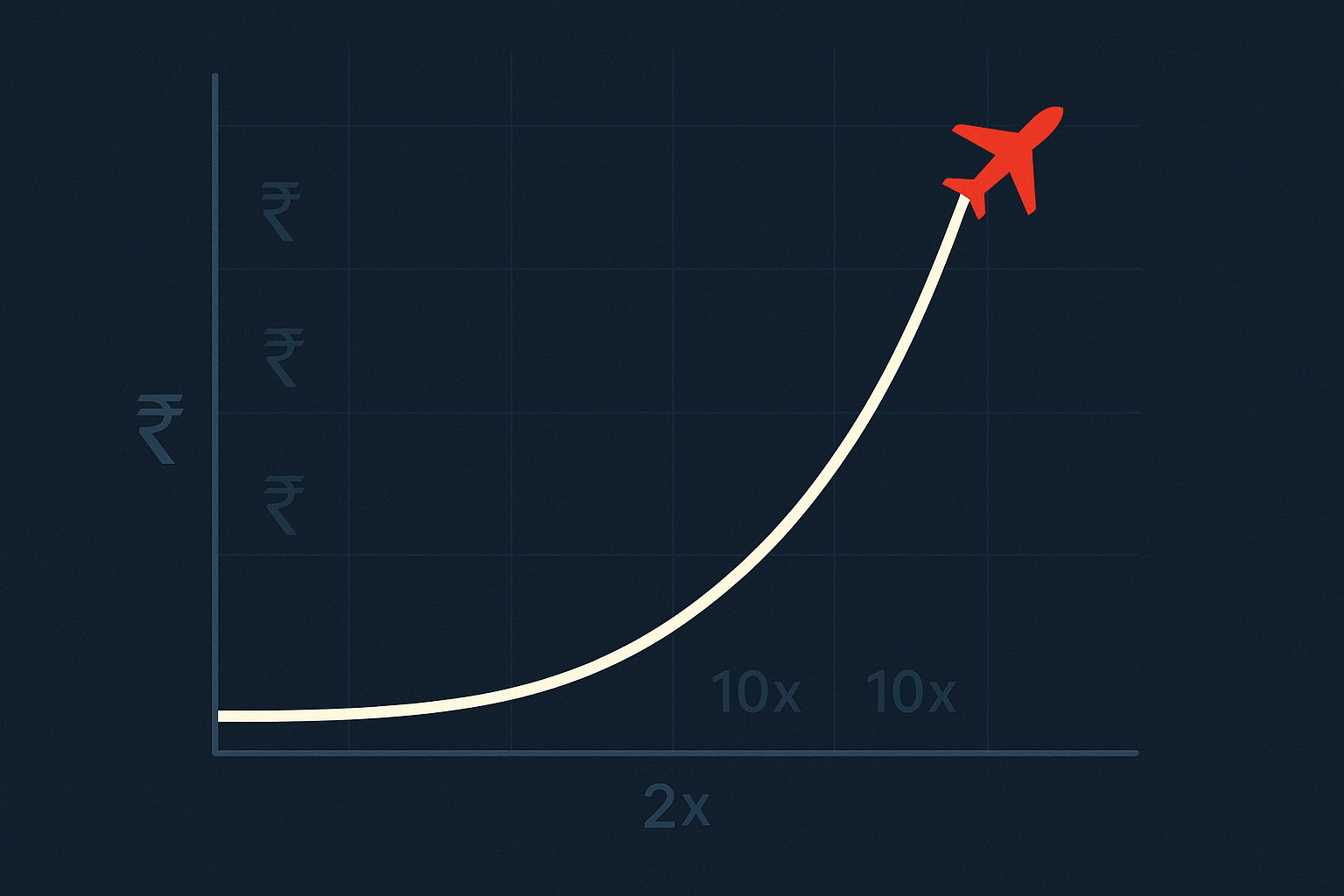
Aviator is a crash game. A plane takes off, a multiplier climbs from 1.00× upward, and it can fly away (crash) at any moment. You get one job: cash out before it goes. Cash out at 2.30× on a ₹100 bet and you collect ₹230. Hesitate a second too long and the stake is gone.
A slot is a spin-and-match game. You set your stake, hit spin, and reels stop on symbols. Matching combinations across paylines, “ways to win”, or clusters pay according to the paytable, and features like wilds, scatters, and free spins can add to it. Once the spin starts, the outcome is already determined by the random number generator — the animation is just presentation.
That’s the fundamental gap in crash game vs slots play. Aviator asks you to make one timing decision per round. A slot asks nothing after you press the button.
| Feature | Aviator (crash game) | Slots |
|---|---|---|
| Core mechanic | Rising multiplier, manual cash-out | Spinning reels, symbol matches |
| Player input after betting | Yes — when to cash out | None |
| Typical RTP | Around 97% (Spribe’s stated figure for Aviator) | Roughly 92%–98%, most commonly 94%–96% |
| Round length | A few seconds to ~30 seconds | 2–5 seconds per spin |
| Variety | One game, one mechanic | Thousands of themes, mechanics, jackpots |
| Fairness check | Provably fair (server and client seeds) | Certified RNG, audited by testing labs |
RTP and house edge: which pays better?
On paper, Aviator has a small edge. Spribe lists Aviator’s RTP at about 97%, which means a house edge of roughly 3%. Online slots usually land between 92% and 98%, with the bulk of popular titles sitting around 94%–96% — a house edge of 4% to 6%.
So an RTP comparison favours Aviator over an average slot, but only slightly, and only across an enormous number of rounds. RTP is a long-run average measured over millions of results, not a session forecast. A 97% game does not hand back ₹97 of every ₹100 you wager tonight.
What the difference does affect is expected cost per amount wagered:
| Game RTP | House edge | Expected long-run cost per ₹10,000 wagered |
|---|---|---|
| 97% | 3% | ₹300 |
| 96% | 4% | ₹400 |
| 94% | 6% | ₹600 |
| 92% | 8% | ₹800 |
Two things matter more than that table suggests. First, wagered volume, not deposit size, drives the cost — a fast player grinding ₹20 bets through hundreds of rounds an hour puts far more through the edge than someone playing 50 spins. Second, slot RTP varies wildly between titles, and some games are shipped in multiple RTP versions, so the same slot can be 96.5% at one casino and 94% at another. Check the game info panel before you play. If you want the mechanics in more detail, see our guide to RTP and house edge.
Player control: timing vs pure chance
Aviator gives you real cash-out control, and this is its genuine differentiator. You choose the exit point. You can set an auto cash-out at, say, 1.50× so the game locks in for you, or place two bets in the same round and cash them out at different multipliers. You can also watch a live feed of when other players cashed out, plus a history strip of recent crash points.
Slots give you no in-round control at all. You control stake size, which game you play, and whether you take a bonus buy if the title offers one. After that, the result is fixed. Stopping the reels early with a tap changes the animation, not the outcome.
Here’s the honest catch, and it’s the part most players get wrong: control over when you exit does not give you control over the edge. Because the crash point is random and independent every round, a cash-out plan of 1.20× and a plan of 20× carry the same expected return in the long run. The low target hits often for small gains; the high target hits rarely for large ones. Both bleed the same 3% over enough rounds. In a fair crash design with 97% RTP, the rough chance of reaching a multiplier of m is about 97 ÷ m percent — around 48% for 2.00×, roughly 19% for 5.00×, under 10% for 10.00×.
What control does change is how the game feels. Cashing out yourself makes wins feel earned and losses feel like mistakes you could have avoided. That near-miss sting — watching a plane fly on to 8× after you bailed at 1.60× — is powerful, and it’s exactly why crash games can pull people into chasing. Slots have their own version of this with scatter near-misses, but nobody blames their own reflexes for a spin.
Recent-results panels don’t help either. The RNG has no memory. A run of five instant crashes tells you nothing about round six. Read our full Aviator game guide for how the rounds, auto-bet and provably fair verification actually work.
Volatility and risk: steady wins vs big swings
Slot volatility is a property of the game; Aviator’s volatility is partly a property of you.
With slots, you can shop for variance. Low volatility titles pay small amounts frequently, so a ₹1,000 bankroll at ₹10 a spin can last a long time with lots of small returns. High volatility slots have low hit frequency and long dry stretches, punctuated by rare big hits, usually in free spins. Same RTP is possible in both cases — volatility describes how the returns are distributed, not how much comes back.
Aviator has one mechanic, but your cash-out target sets the risk profile. Auto cash-out at 1.30× behaves like a low volatility game: frequent small wins, occasional stings when the plane crashes early. Holding for 20×–50× behaves like an extremely high volatility slot: dozens of losing rounds for one big multiplier, if it comes at all.
For bankroll management, the practical numbers matter more than the labels:
- Set a session budget first, then size bets at 1%–2% of it. On ₹2,000, that’s ₹20–₹40 per round or spin.
- Expect losing streaks and do the arithmetic. At a 2.00× target in Aviator, each round succeeds only about 48.5% of the time, so the chance of missing five in a row is roughly 0.5155 ≈ 3.6% — about one in every 28 sets of five attempts. Play a couple of hundred rounds and streaks like that will turn up.
- Watch your round rate. Aviator rounds are quick and it’s easy to place 200 bets in an hour without noticing. Speed multiplies the house edge, not the fun.
- Never increase stakes to recover losses. Doubling up doesn’t change the math; it just shortens how long your money lasts.
Our slots basics guide covers how to read a game’s volatility rating and paytable before you commit real money.
Which game is right for you?
There’s no better game here, only a better fit. Use this as a rough filter:
- You want a decision to make: Aviator. It’s the only one of the two where your input during the round matters.
- You want variety and features: slots. Thousands of titles, different mechanics (Megaways, cluster pays, bonus buys), themes, and progressive jackpots that crash games simply don’t offer.
- Which is better for beginners? Usually a low or medium volatility slot with a published RTP of 96% or higher, played at small stakes. Nothing to time, nothing to panic about, and the paytable tells you what everything pays. If you do start with Aviator, use auto cash-out at a modest multiplier so you’re not making split-second calls with real money.
- You have limited time and a small budget: slots, played slowly. Manual spins at low stakes give you the most rounds per rupee at your own pace.
- You chase big multipliers and can accept long losing runs: either works. High volatility slots and high cash-out targets in Aviator produce a similar pattern — rare, large results and plenty of empty rounds in between.
- You dislike near-miss regret: slots. If second-guessing your own timing would bother you or push you to bet more, the predetermined spin is kinder on the head.
Experienced players often use both for different reasons: Aviator when they want short, engaged sessions, slots when they want to sit back. Neither choice is a strategy for winning.
The bottom line: both are games of chance
Whichever you pick, you’re playing a game of chance with a built-in house edge. Aviator’s crash point and a slot’s reel stops both come from a random number generator, and each result is independent of the last. No pattern-reading, no betting progression, and no cash-out system changes the expected return. Aviator’s 3% edge and a slot’s 4%–6% edge are the price of playing, and over time the house collects it.
Treat both as paid entertainment. Set a deposit or loss limit before you start, use session reminders if your casino offers them, and stop when the budget is spent rather than when you feel due for a win. If play stops feeling optional, use the cool-off and self-exclusion tools in your account, or the support options listed in our responsible gambling resources. Play only if you’re of legal age in your jurisdiction.
FAQ
What’s the difference between Aviator and slots?
Aviator is a crash game with one rising multiplier per round that you must cash out manually before it crashes. Slots are spin-and-match games where the result is decided by the RNG the moment you press spin, with wins paid from a fixed paytable.
Which has a better RTP?
Aviator’s stated RTP is around 97% (about a 3% house edge), which beats the typical slot’s 94%–96%. Some slots do reach 97%–98%, so the gap depends on the specific title. RTP is a long-run average, not a session outcome.
Does Aviator give more control than slots?
Yes, over timing. You choose your cash-out point, or set an auto cash-out. But timing doesn’t change the house edge — every crash point is random, so different cash-out targets carry the same long-run expected return with different win frequencies.
Which is better for beginners?
A low or medium volatility slot with 96%+ RTP at small stakes is the gentler start: no timing pressure and a clear paytable. Beginners who prefer Aviator should use auto cash-out at a low multiplier and a fixed session budget.