The Aviator house edge is 3%, which is the flip side of the game’s published RTP of 97%. In plain terms: for every ₹100 wagered across a very large number of rounds, the game returns about ₹97 on average and keeps about ₹3. That gap is fixed by design, it applies to every player, and no cash-out pattern removes it. Everything else below is the detail behind that one sentence.
What are RTP and house edge in Aviator?
RTP (Return to Player) is the long-run percentage of all money wagered that a game pays back, averaged over millions of rounds. House edge is what’s left over: 100% − RTP. Spribe, the studio behind Aviator, states the game’s RTP as 97% in its game rules, so the Aviator house edge is 3%.
Two things people routinely get wrong about this figure:
- It’s an average, not a session promise. A 97% RTP does not mean you get ₹97 back from ₹100. In a single round you either lose your stake or collect stake × multiplier. The 97% only shows up across an enormous sample of rounds.
- It’s charged on turnover, not on deposits. If you bet ₹100 a round for 200 rounds, you’ve wagered ₹20,000, not ₹100. The expected cost of that activity is roughly 3% of ₹20,000, or about ₹600 — even though you may have deposited far less and recycled winnings.
By crash-game standards 97% is competitive; plenty of slots sit in the 94–96% range. But “better than average” still means the expected value of every bet is negative. That’s the honest baseline for any discussion of crash game strategy.
How Aviator’s multiplier probability works
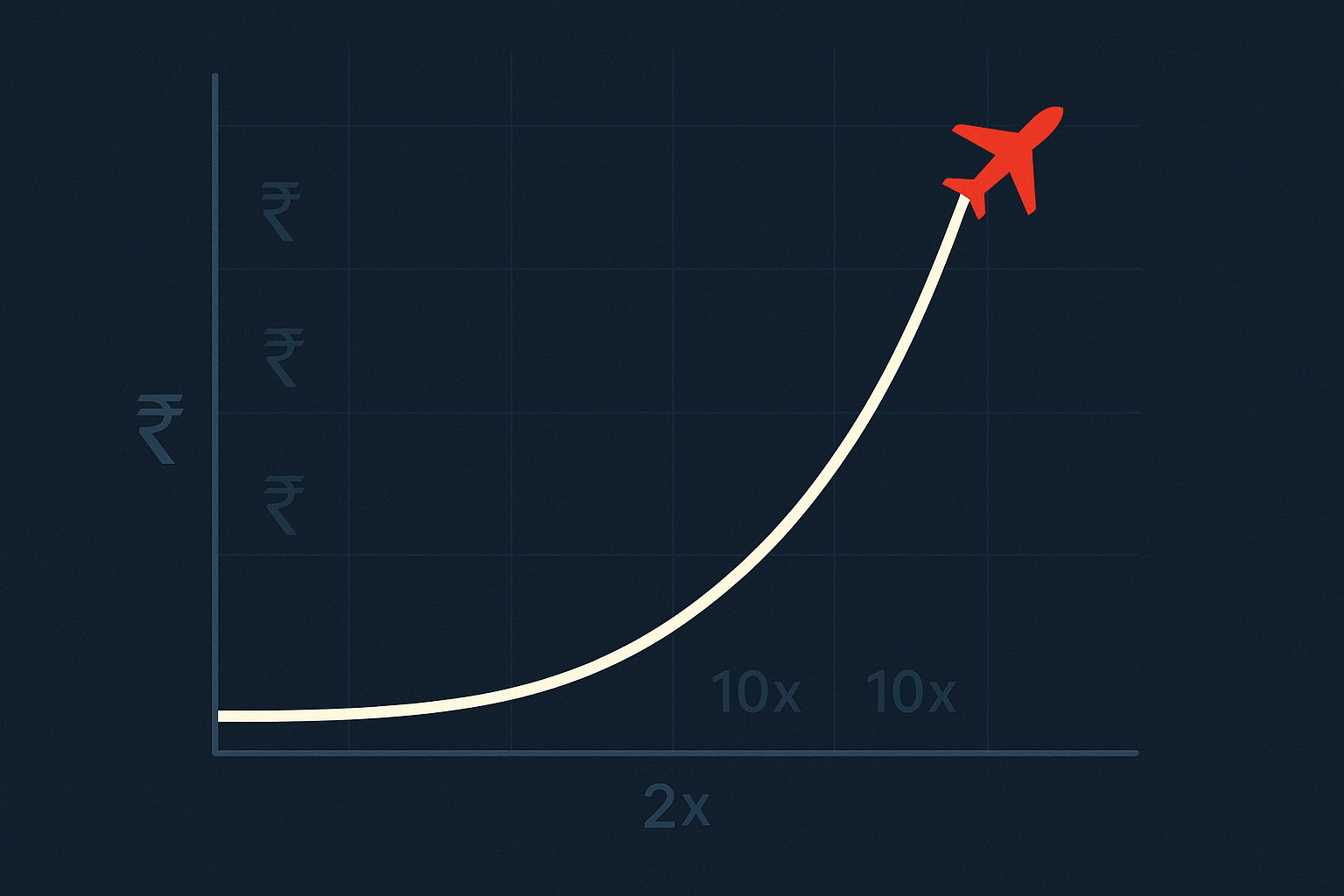
Each round, a multiplier starts at 1.00× and climbs until the plane flies away. The moment it flies away is the crash point, and it’s drawn randomly for that round. The important structural fact is that high multipliers aren’t just “rarer” — they get rarer in almost exact proportion to how much they pay.
The crash point algorithm
Aviator is provably fair: the crash point for a round is generated from a combination of a server seed and seeds contributed by players, then hashed, so the result can be verified afterwards and can’t be adjusted once betting closes. The exact distribution Spribe uses is its own, but the shape it must have is determined by the RTP, and you can reason it out without any formulas.
For the game to return 97% no matter which target you pick, the chance of the round reaching a multiplier of m or higher has to be roughly 97 ÷ m (as a percentage). Double your target and you roughly halve your chance of getting there. That single relationship generates the whole curve:
| Cash-out target | Approx. chance of reaching it | Payout on ₹100 stake | Expected return per ₹100 |
|---|---|---|---|
| 1.50× | ~64.7% | ₹150 | ≈ ₹97 |
| 2.00× | ~48.5% | ₹200 | ≈ ₹97 |
| 3.00× | ~32.3% | ₹300 | ≈ ₹97 |
| 5.00× | ~19.4% | ₹500 | ≈ ₹97 |
| 10.00× | ~9.7% | ₹1,000 | ≈ ₹97 |
| 20.00× | ~4.9% | ₹2,000 | ≈ ₹97 |
| 50.00× | ~1.9% | ₹5,000 | ≈ ₹97 |
| 100.00× | ~1.0% | ₹10,000 | ≈ ₹97 |
These are modelled figures consistent with a flat 97% RTP, not numbers published by the provider — treat them as the shape of the curve rather than decimal-perfect odds. The point of the last column is the part that matters: it doesn’t move. Chasing 100× isn’t mathematically worse than banking 1.5×, it’s just far swingier.
Why 1× crashes happen most often
Instant crashes at 1.00× feel unfair, and they’re the single most complained-about feature of crash games. They’re also structural. If the chance of reaching any multiplier m is about 97/m, then the chance of the round surviving even to 1.00× is about 97% — which leaves roughly 3% of rounds ending immediately, with nobody able to cash out. That’s exactly where the house edge lives in a crash game.
So the 3% edge isn’t skimmed off each payout; it’s collected through a small slice of rounds that die on the runway. In a 1% house edge crash game you’d see instant busts about a third as often. Nothing is being “triggered” by your bet size or your last win — each round’s seed is independent of the previous one.
Which also kills the pattern-reading habit. The RNG has no memory. Five red 1.02× rounds in a row do not make a big multiplier due, and a fresh 200× does not mean the game now needs to “take it back”. Believing otherwise is the gambler’s fallacy, and Aviator’s round history display makes it very easy to fall into.
Expected value: what each bet really returns
Expected value (EV) is the average result of a bet if you could repeat it endlessly. For Aviator it is always negative, by exactly the house edge. Two worked examples with a ₹100 stake:
- Auto cash-out at 2.00×. You win ₹200 about 48.5% of the time and lose ₹100 the rest. Expected return: 0.485 × ₹200 ≈ ₹97. Net EV: −₹3 per round.
- Auto cash-out at 10.00×. You win ₹1,000 about 9.7% of the time. Expected return: 0.097 × ₹1,000 ≈ ₹97. Net EV: −₹3 per round.
Same expected loss, wildly different experience. The 2× approach wins nearly half its rounds; the 10× approach loses nine rounds in ten and needs a bankroll that can absorb long dry spells. That difference is volatility, and volatility never touches RTP.
Scaled up, the arithmetic is blunt. Play 500 rounds at ₹100 and you’ve put ₹50,000 through the game, with an expected loss of around ₹1,500. Your actual result will almost certainly not be −₹1,500 — short-run variance is large enough that plenty of sessions finish ahead. That’s the nature of a negative-EV game with high variance: winning sessions exist, and they don’t change the long-run direction.
Does auto cash-out change your odds?
No. Auto cash-out changes when you exit, not the probability curve behind the crash point. As the table above shows, every target returns the same ≈97% of turnover, so switching from manual to auto, or from 1.8× to 4×, alters the shape of your results without altering the expected return.
What auto cash-out genuinely does help with is discipline and execution. It removes reaction-time slippage, and it stops the “one more second” impulse that turns a locked-in 2.1× into a loss. Useful, but it’s a behaviour tool, not an edge.
The same applies to the two-bet panel, auto-play, and staking patterns like doubling after a loss. Progressive staking redistributes your losses into fewer, larger events; it doesn’t reduce the 3%. Any system marketed as beating a crash game is describing volatility, not mathematics.
Skill vs chance: what players actually control
Aviator involves decisions, which is why it feels more skill-based than a slot. Mechanically it’s still chance. The crash point is fixed by the RNG and the provably fair seeds before the round starts, and no information about it is revealed while the multiplier climbs. You are timing a number you cannot see and cannot influence.
What you do control:
- Stake size and whether to use one or both bet slots
- Your cash-out target, and therefore your volatility
- How many rounds you play and when you stop
- Deposit, loss and session limits on your account
What you don’t control: the crash point, the 3% house edge, and the order in which results arrive. Skill in crash game math is really bankroll and risk management — it can shape the ride and slow the burn, but the arithmetic keeps running in the house’s favour. If you’re new to the format, the mechanics are covered in more detail in our guide to how Aviator works.
Understanding the math before you play
Three things to carry away. First, Aviator’s 97% RTP and 3% house edge are built into the crash distribution itself, largely through those instant 1.00× rounds, and they apply to every player equally. Second, no cash-out target, auto setting, or staking pattern changes the expected return — a low target wins often and small, a high target wins rarely and big, and both give back about ₹97 per ₹100 wagered over the long run. Third, the cost you pay is a percentage of everything you wager, not of what you deposit, so how long you play matters more than how much you started with.
Knowing the math is worth something: it makes the game’s behaviour predictable and stops you from paying for “systems” that are only repackaged volatility. It does not turn a negative-EV game positive. Set a deposit and loss limit before you start, treat the stake as entertainment spend you can afford to lose, and use the cool-off or self-exclusion tools if play stops feeling like a choice. Our responsible gambling guide lists the limit settings and support options worth knowing about. Aviator is 18+ only.