How much tax do you pay on online betting winnings in India?
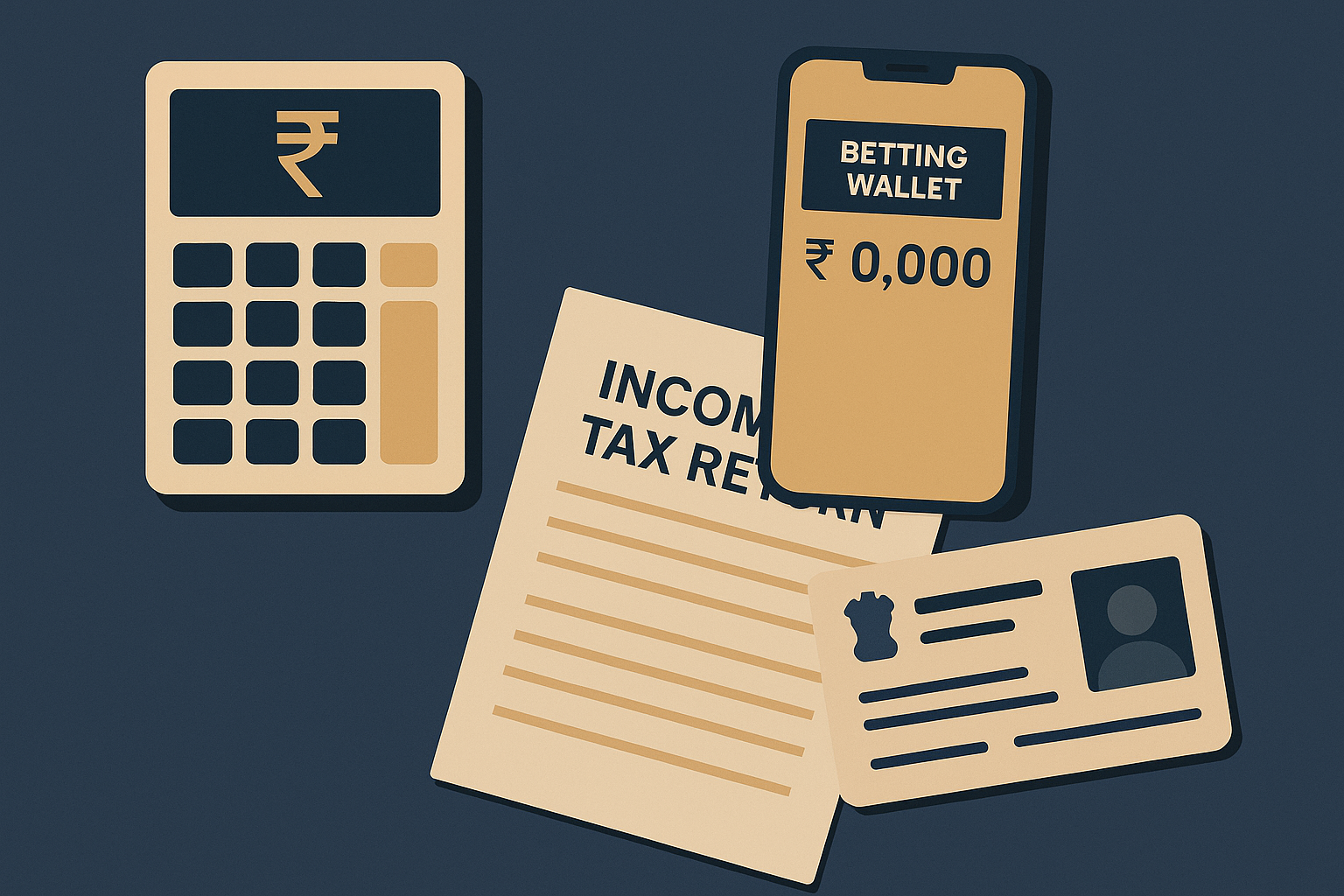
Winnings from online games and betting are taxed at a flat 30% in India, with no exemption threshold and no slab benefit. That is the short answer to the tax on betting winnings India question, and it applies whether you won ₹500 on a slot or ₹5 lakh on a cricket market. A 4% health and education cess is added when your return is assessed, so the effective rate works out to about 31.2%.
A few things make this income unusual compared with salary or interest:
- There is no basic exemption limit for it. Even if your total annual income is below the taxable threshold, winnings are still taxed at 30%.
- You cannot claim deductions or expenses against it, and you cannot set off gambling losses against winnings or against any other income.
- Deductions under Chapter VI-A (like 80C investments) don’t reduce this portion of your income.
The relevant provisions are Section 115BBJ of the Income-tax Act, 1961 (which taxes net winnings from online games at 30%) and Section 194BA (which requires the operator to deduct that tax at source). The game doesn’t matter: income tax on Aviator winnings, Teen Patti, Andar Bahar, slots, fantasy sport or sports betting is treated the same way.
This 30% is income tax. It is completely separate from the GST charged on money you put in, which we cover further down. Two different taxes, two different bases.
What is TDS on gambling winnings?
TDS stands for tax deducted at source. It’s a withholding tax: instead of you paying the 30% yourself at the end of the year, the operator deducts it before the money reaches your bank account and deposits it with the government against your PAN. TDS on gambling winnings from online games is 30% of net winnings, with no minimum threshold.
“Net winnings” is not the same as the size of a single win. Broadly, it is what you take out (plus what’s left in your wallet at year end) minus what you put in. In formula terms, for a financial year:
Net winnings = (total withdrawals + closing wallet balance) − (total deposits + opening wallet balance)
So if you deposit ₹20,000 over the year and withdraw ₹18,000, there are no net winnings and no TDS, even if you hit some big multipliers along the way. The rules for computing this are prescribed under Rule 133 and CBDT guidance. Non-withdrawable bonus credits and promotional balances get specific treatment under that guidance, which is one more reason to check your operator’s terms and your own statements rather than assume.
When is TDS deducted?
Two trigger points:
- At withdrawal. Each time you withdraw from your gaming wallet, the operator computes net winnings up to that point and deducts 30% on the portion not already taxed. That’s why your bank credit is often smaller than the amount you requested.
- At the end of the financial year. On 31 March, tax is deducted on any net winnings still sitting in your account balance, even though you haven’t withdrawn it.
CBDT guidance allows a small-value relaxation: where net winnings in a withdrawal are ₹100 or less in a month, the operator may skip deduction at that point and account for the tax later. It’s a timing concession, not an exemption.
Two practical warnings. First, keep your PAN details correct and your KYC verification complete, otherwise TDS credit may not land against your PAN and you’ll struggle to claim it. Second, many offshore sites that accept Indian players don’t deduct TDS at all. That doesn’t make the income tax free. The liability to declare the winnings and pay the 30% stays with you, and you’ll be paying it out of pocket at filing time instead of having it withheld.
Getting your TDS certificate
The TDS certificate for non-salary payments is Form 16A, issued quarterly by the deductor. Request it from the operator’s support or download it from your account section if they provide one. Independently, check two records on the Income Tax Department portal:
- Form 26AS — the consolidated tax statement showing TDS credited against your PAN.
- Annual Information Statement (AIS) — a wider statement of reported transactions.
If the deduction shows in your bank credit but not in 26AS, chase the operator. You can only claim credit for tax that has actually been reported against your PAN. Both statements are available at incometax.gov.in.
GST on casino deposits: a separate tax
Since 1 October 2023, online money gaming attracts 28% GST on the full face value of the amount you deposit, not on your winnings and not on the operator’s margin. GST on casino deposits is an indirect tax collected by the supplier and paid to the government; it has nothing to do with your income tax return and you cannot claim it back as a player.
How it shows up depends on the platform. Some show GST as an addition on top of your deposit; others take it out of the amount you send, so a ₹10,000 transfer credits less than ₹10,000 to your playable balance. On a GST-inclusive ₹10,000 deposit, the tax component is ₹10,000 × 28/128 = ₹2,187.50, leaving ₹7,812.50 to play with. If GST is charged on top instead, ₹10,000 of playable balance costs you ₹12,800. Read the cashier screen and the terms before you fund your account, and see our guide to payment methods for Indian players for how deposits are processed.
Here’s the difference between the two taxes at a glance:
| GST | Income tax / TDS | |
|---|---|---|
| Charged on | The amount you deposit | Your net winnings |
| Rate | 28% of deposit value | 30% (plus 4% cess at assessment) |
| Collected by | The gaming operator, as GST | The operator, as TDS under Section 194BA |
| When | At the time of deposit | At each withdrawal and on 31 March |
| Appears in your ITR? | No | Yes, as income from other sources |
| Refundable to you? | No | Excess TDS can be refunded via your return |
Worked examples: what gets deducted
Round numbers below, GST treated separately from the income tax calculation so the 30% tax on online gaming math stays clear. Your operator’s statement is the authority for your own figures.
Example 1: small win
You deposit ₹10,000 during the year, build the balance to ₹15,000 and withdraw the lot. Wallet balance on 31 March: nil.
- Net winnings = ₹15,000 − ₹10,000 = ₹5,000
- TDS at 30% = ₹1,500
- Credited to your bank = ₹13,500
At filing, the ₹5,000 goes into your return, the ₹1,500 is claimed as TDS credit, and the 4% cess (₹60) is payable as a balance. If GST was deducted from your ₹10,000 deposit at 28% inclusive, another ₹2,187.50 left your pocket at the deposit stage, which the income tax calculation ignores.
Example 2: larger win across a year
Over one financial year you deposit ₹50,000 in total, withdraw ₹2,00,000 in several requests, and finish 31 March with ₹10,000 still in the wallet.
| Item | Amount |
|---|---|
| Total withdrawals | ₹2,00,000 |
| Closing wallet balance (31 March) | ₹10,000 |
| Less: total deposits | −₹50,000 |
| Less: opening balance | −₹0 |
| Net winnings | ₹1,60,000 |
| TDS at 30% | ₹48,000 |
That ₹48,000 isn’t taken in one hit. It builds up across withdrawals, and the deduction on the ₹10,000 remaining balance happens at year end. Add 4% cess at assessment and the total tax on this income is ₹49,920, so roughly ₹1,920 would still be payable when you file.
Example 3: a losing year
Deposits ₹20,000, withdrawals ₹8,000, closing balance nil. Net winnings are negative, so there is no TDS and nothing to report as winnings. The ₹12,000 shortfall is not deductible against your salary, business income or anything else. Gambling losses simply don’t offset other income in India.
Do you need to declare betting winnings in your ITR?
Yes. TDS is an advance collection, not a settlement. Filing your income tax return is still required, and the winnings must be reported even if the full 30% was already withheld. This is the part players most often get wrong.
How to declare betting winnings India, step by step:
- Pick the right form. ITR-1 cannot be used when you have income from lotteries or games, so most players with winnings file ITR-2 (or ITR-3 if they have business income).
- Report the amount under income from other sources. Winnings from online games are shown in the schedule for other sources at the special 30% rate, separate from your normal slab income.
- Claim the TDS credit. Enter the deductor’s TAN and the tax deducted in the TDS schedule, matching Form 26AS and your Form 16A.
- Pay any balance. Because resident TDS is deducted at 30% without cess, a small amount (the 4% cess, plus surcharge if your total income crosses the surcharge thresholds) is usually payable as self-assessment tax.
- File by the due date. For individuals not subject to audit, that is 31 July following the end of the financial year, unless the department extends it.
Two situations create a refund rather than a payment: TDS deducted on gross amounts by mistake, or over-deduction across multiple platforms. You get that back only by filing. And if no TDS was deducted at all, say on an offshore site, the 30% still has to be paid by you directly, ideally as advance tax during the year to avoid interest under Sections 234B and 234C.
Record keeping and documentation
Your ITR is only as good as your paperwork, and gaming wallets can produce hundreds of transactions in a year. Keep these for every platform you use:
- Form 16A / TDS certificates for each quarter in which tax was deducted.
- Full deposit and withdrawal statements, downloaded before you close or abandon an account.
- Bank or UPI statements showing the actual credits, which help reconcile gross withdrawal against net receipt.
- Opening and closing wallet balances as on 1 April and 31 March.
- Screenshots or emails showing how GST was applied to deposits, if it was.
- Your Form 26AS and AIS downloads for the year.
Keep the file for at least six years after the end of the financial year. Assessments and notices can arrive well after you’ve filed, and reconstructing a year’s wallet history from memory is not a fight you want to have. A simple spreadsheet with date, platform, deposit, withdrawal and TDS is enough for most players and takes minutes a month.
One more reason documentation matters: banks and the department both see the money moving. Large credits with no corresponding entry in your return are exactly the kind of mismatch that triggers a query.
FAQs
How much tax is deducted on online betting winnings in India?
30% of net winnings, deducted at source by the operator, with no minimum threshold. A 4% health and education cess is added when your return is assessed, taking the effective rate to about 31.2%.
What is TDS on gaming winnings?
Tax deducted at source under Section 194BA. The operator withholds 30% of your net winnings before paying you and deposits it against your PAN, then issues Form 16A as proof.
Is GST charged on my deposit?
Yes, online money gaming attracts 28% GST on the deposit amount. It is separate from income tax, is not refundable to you, and does not appear in your ITR.
Do I have to file winnings in my ITR?
Yes. TDS does not remove the filing obligation. Report the winnings under income from other sources at the special 30% rate, claim the TDS credit, and pay any cess or surcharge balance.
Can I set off my losses against my winnings?
No. Losses from gambling cannot be set off against winnings or any other income, and cannot be carried forward.
Before you file
Tax rules change, and the treatment of online gaming has changed more than once in recent years. Verify current rates and provisions on the official portals, incometax.gov.in and gst.gov.in, and get a chartered accountant to look at your numbers if the amounts are meaningful. This article is general information, not tax advice for your situation.
Finally, the honest framing: every casino game and betting market carries a built-in house edge, so over time the maths favours the operator, and tax applies to the winnings that do come in. Play with money you can afford to lose, use deposit and loss limits, and read our responsible gambling guide if the fun has stopped. Support in India is available through Helpline services listed on that page.