A progressive jackpot is a prize pool that grows a little with every real-money bet placed on the game, until one player triggers it and the pool resets to a starting value. That’s the whole idea in one line. The interesting part, and the part most players never look at, is the plumbing underneath: where the money comes from, how much of your stake actually feeds the meter, and what that does to the odds. This is progressive jackpot explained from the maths side, with rupee examples throughout.
Progressive jackpot explained: what it actually is
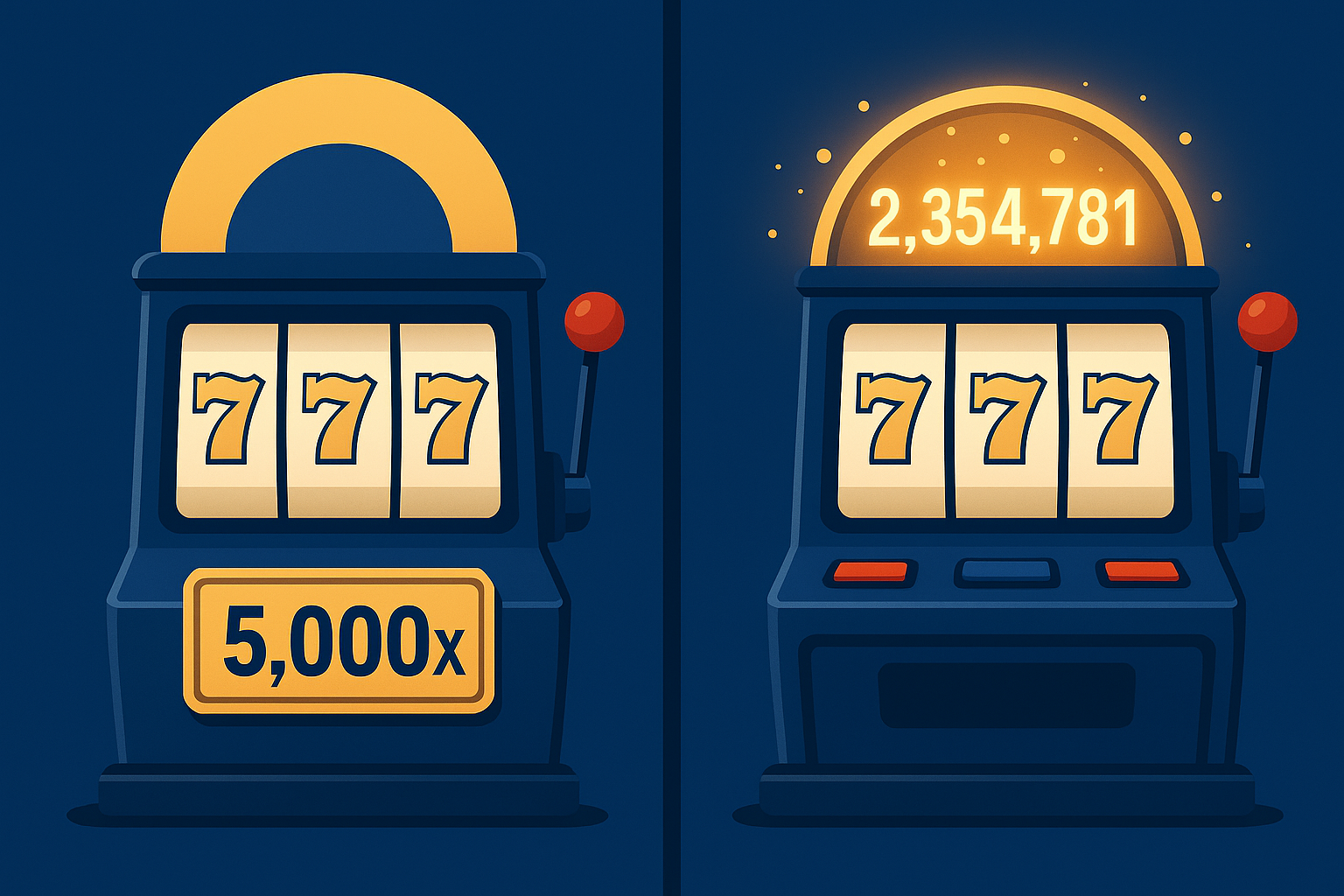
In a fixed-jackpot slot, the top prize is written into the paytable and never moves. Land five wilds at ₹100 a spin and you win the stated amount, whether you’re the first player of the day or the ten-thousandth.
In a progressive slot, the top prize is a shared pot. A small slice of every qualifying bet, from you and from everyone else playing that game, gets diverted into the pot instead of being paid back through normal wins. The meter ticks upward in real time. When someone hits it, the pot empties, resets to its seed amount, and starts climbing again.
Fixed vs progressive: key differences
The fixed vs progressive jackpot question comes down to prize size versus how the return is distributed.
| Feature | Fixed jackpot | Progressive jackpot |
|---|---|---|
| Top prize | Set in the paytable, e.g. ₹10,000 at a ₹100 stake | Variable, often ₹5 lakh to several crore on wide-area games |
| Funded by | The game’s normal RTP | A contribution skimmed from every bet |
| Base game returns | Usually higher | Usually lower, because part of the RTP is locked in the meter |
| Odds of top prize | Long, but often in the hundreds of thousands to one | Far longer, frequently millions to one on major tiers |
| Bet requirements | Rarely any | Often a minimum bet, side bet, or scaling qualification |
| Best suited to | Steadier sessions, smaller bankrolls | Players who accept very high variance for a shot at a life-changing sum |
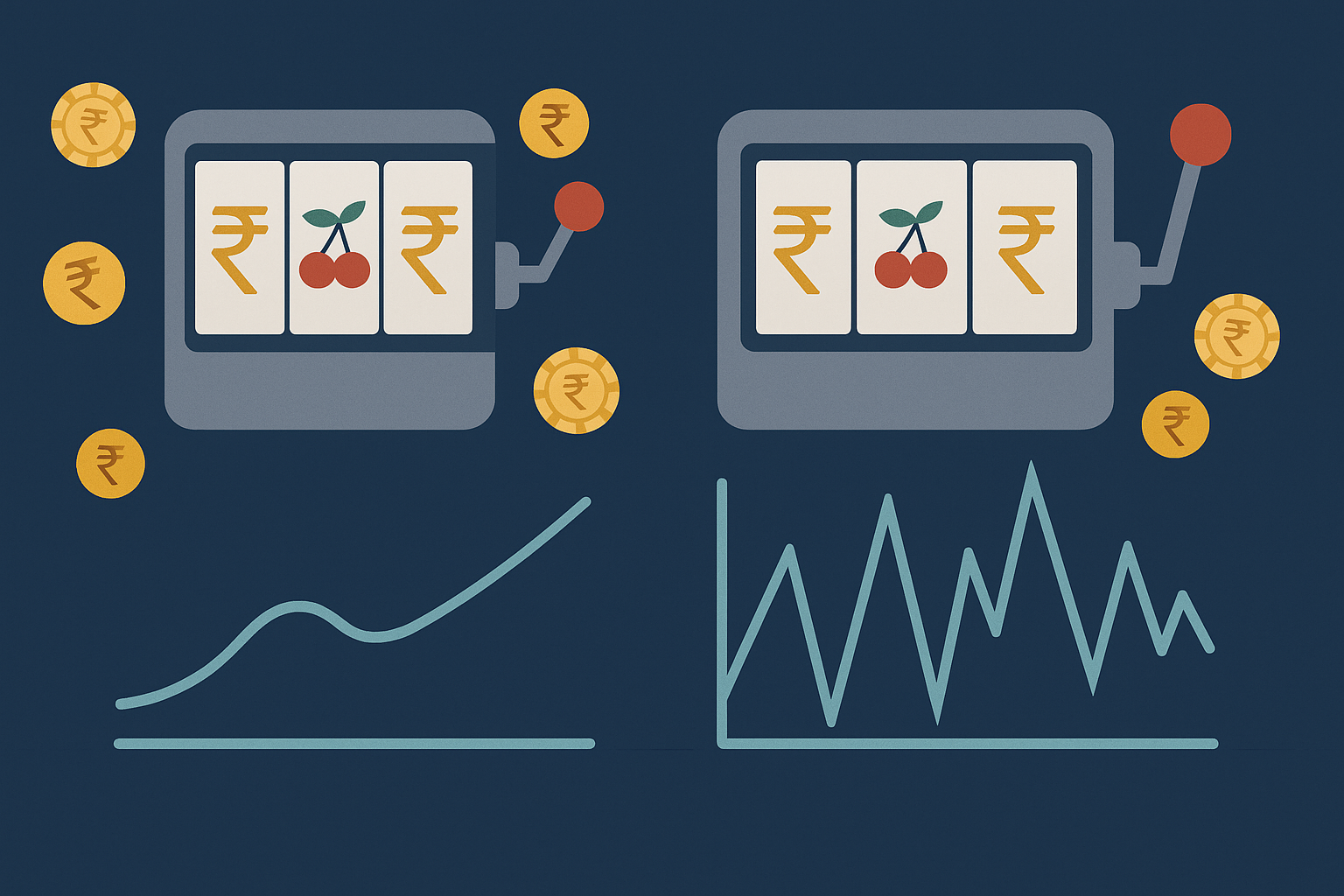
Neither type is “better value” by default. A fixed-jackpot slot with 96% RTP returns more per spin on average than a progressive whose base game sits in the high 80s or low 90s, but the progressive holds back that difference for one enormous payout. Same house edge logic, very different shape of returns. If those terms are new, our explainer on RTP and volatility covers the basics.
How does a progressive jackpot grow?
Three mechanics do all the work: the seed amount, the contribution rate, and the volume of bets flowing through the game.
The seed amount
The seed is the value the jackpot resets to after a win, and it is funded by the operator or the game supplier, not by the next player’s first spin. Without a seed, a freshly-won progressive would restart at zero and nobody would play it.
Seeds vary enormously by tier. A small in-game “Mini” jackpot might seed at ₹500. A local network progressive might seed at ₹50,000. Microgaming’s Mega Moolah, the most famous wide-area progressive of all, has long carried a headline jackpot that resets to €1 million, several crore rupees, which is why its meter never looks small.
Contribution rate breakdown
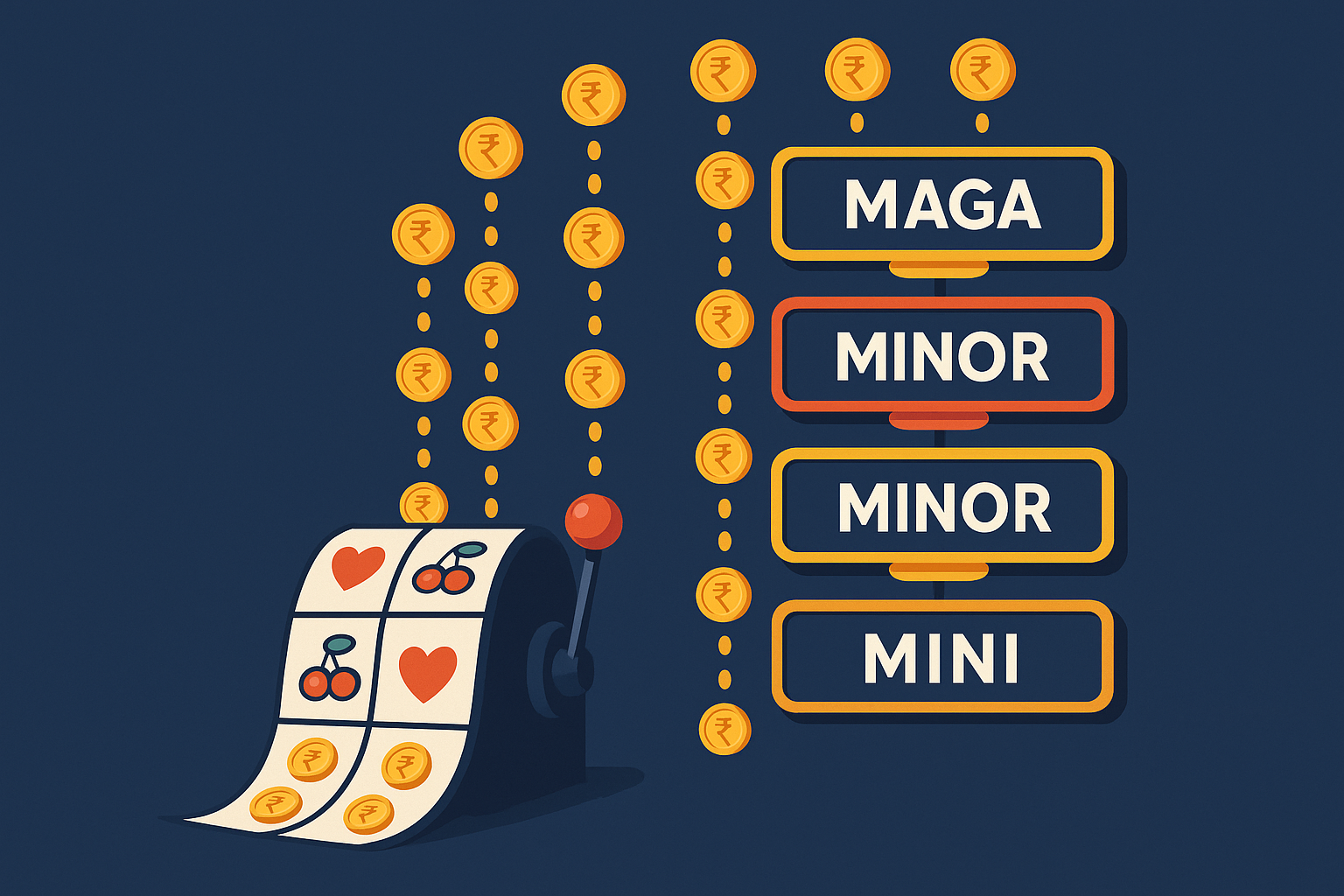
The jackpot contribution rate is the percentage of each qualifying bet that is diverted into the pool. Typical rates sit somewhere around 1% to 5% of the stake, though it varies by game and operator, and multi-tier games split that percentage across the tiers.
Worked example. Say a slot takes 3% of every bet for its jackpots, spread as follows. These figures are illustrative, not from a specific game, but the structure is standard:
| Tier | Share of stake | From a ₹100 spin | Example seed |
|---|---|---|---|
| Mini | 0.5% | ₹0.50 | ₹500 |
| Minor | 0.5% | ₹0.50 | ₹5,000 |
| Major | 0.7% | ₹0.70 | ₹50,000 |
| Mega | 1.3% | ₹1.30 | ₹5,00,000 |
On its own, ₹1.30 per spin toward the Mega tier looks trivial. Scale it up and the picture changes. If 2,000 players each spin 300 times a day at ₹100, that’s 600,000 spins, and the Mega meter gains roughly ₹7.8 lakh in a single day. Wide-area jackpots linked across dozens of casinos in multiple countries can add far more than that, which is how they reach crore-level figures within weeks.
Note where that money comes from: your average return per spin. A game advertising 96% RTP with a 3% jackpot contribution is paying you about 93% through normal wins and holding 3% in the meters. You get it back only if someone at your table, eventually, hits the pot. Long run, the house edge is still the house edge.
Types of progressive jackpots
Progressives are grouped by how wide the pool is shared, and the jackpot contribution rate feeds a bigger or smaller pot accordingly.
Standalone progressive slots
A standalone progressive collects contributions from one game on one machine or one operator’s single instance of it. Nobody else’s bets feed your meter. Pools stay small, often a few thousand to a few lakh rupees, but they hit far more often and the qualifying bet is usually low. Old-school land-based machines and some retro online slots work this way.
Network progressive jackpots
A local network jackpot links several games inside one casino or one operator’s platform. A wide-area network jackpot links games across many casinos, often across countries, all feeding a single meter run by the game supplier.
| Type | Pool fed by | Typical size | Hit frequency | Trade-off |
|---|---|---|---|---|
| Standalone | One game, one operator | Thousands to a few lakh | Relatively often | Small prize, better odds, low bet requirement |
| Local network | Several games at one casino | Lakhs | Occasional | Middle ground on both size and odds |
| Wide-area network | Many casinos, one supplier | Lakhs to crores | Rare, sometimes months apart | Huge prize, brutal odds, lower base-game RTP |
One practical detail on wide-area games: because the pool is shared globally, the meter you see is the same one every other player sees. Your spin and a spin from a player in another country are competing for the same pot at the same moment.
What are must-drop jackpots?
A must-drop jackpot, sometimes called a mystery jackpot, is a progressive with a guaranteed trigger condition. It must pay out before a set ceiling amount, or before a deadline such as the end of the hour or the end of the day. Red Tiger’s daily and hourly drop jackpots are a well-known example of the time-based version.
Mechanically, the game picks a hidden trigger value in advance, for example “this jackpot will drop somewhere between ₹40,000 and ₹50,000,” or a hidden trigger time. The pot still grows from player contributions, but it cannot climb past the ceiling. Someone playing at that moment wins it, usually chosen at random among active qualifying players rather than by landing a symbol combination.
Compared with a traditional progressive, must-drops behave differently in three ways:
- They hit far more often, because the ceiling caps how big they can get.
- The prizes are much smaller, typically thousands or lakhs rather than crores.
- Timing matters in a limited sense. A daily-drop meter sitting near its historical ceiling is closer to its trigger than one that has just reset. That reduces uncertainty about when, but it does not tell you who, and the winner is still random among everyone playing.
Worth being blunt here: a nearly-full must-drop meter does not make you likely to win it. Thousands of other players are spinning the same game for the same drop.
What are the odds of hitting a progressive jackpot?
Long. For major wide-area progressives, published and estimated odds are usually somewhere in the millions to one per qualifying spin, and for the largest headline jackpots the figures commonly quoted run into the tens of millions to one. Smaller in-game tiers are much friendlier, sometimes in the tens of thousands to one, and must-drop jackpots better still.
Put that in context. At one spin every four seconds, 900 spins an hour, a 20 million to one chance would take roughly 22,000 hours of continuous play to reach a single expected hit. That is the scale we’re talking about, and it’s why jackpot wins are news stories rather than routine events.
Why progressive odds are so long
The maths is forced by the prize size. If a jackpot pays ₹5 crore and is funded at ₹1.30 per ₹100 spin, the pool needs roughly 3.85 crore spins of that size to build from a small seed to that figure. The trigger probability has to be long enough that the pot has time to grow, otherwise the game would pay out more than it collects. Prize size and hit probability are two ends of the same equation.
Two things follow from that. Bigger jackpot, longer odds, always. And because the outcome is decided by an RNG on each independent spin, a meter that has been climbing for six months is no more “due” than one that reset yesterday. There is no hot or cold progressive.
Progressive jackpot strategy for Indian players
There is no method that beats the house edge on a progressive slot, and anyone selling one is selling nothing. What you can control is eligibility, stake sizing, and whether the game suits your bankroll at all.
- Check the qualifying bet before you spin. Some progressives need a minimum bet, some need an optional side bet, and on some games the chance of triggering the jackpot scales with stake size, so a ₹20 spin has a smaller share than a ₹200 spin. If you’re not betting at the qualifying level, you are paying the jackpot contribution without being in the draw. Read the paytable, not the promo banner.
- Accept the volatility. A progressive’s base game usually returns less than a standard slot because part of the RTP sits in the meter. Expect longer dry stretches. Size your stake so a session of 200 to 300 spins fits inside money you’re comfortable losing entirely.
- Understand when a progressive is “mathematically better”, and when it isn’t. The theoretical return of a progressive rises as the meter grows, because the same trigger probability now pays a bigger prize. On rare games with published trigger odds, a very large meter can push theoretical RTP close to or above 100%. That is a long-run figure across millions of spins spread over every player in the network, not a plan for your Saturday night. With odds in the millions to one, the practical experience for an individual player is still a losing one.
- Factor in tax on winnings. In India, winnings from online games are taxable and TDS applies to net winnings. A headline jackpot figure is not what lands in your bank account. Treat this as general information and check current rules with a tax professional.
- Prefer smaller tiers if the goal is actually winning something. Mini, Minor and must-drop jackpots pay out regularly. The Mega tier is the lottery ticket in the package.
If you want the broader context on why these games attract so much attention despite the odds, read our piece on what makes casino jackpots so popular.
FAQ
How does a progressive jackpot grow?
It starts at a seed amount funded by the operator or game supplier, then grows by a fixed percentage of every qualifying bet, typically around 1% to 5% of the stake. On multi-tier games that percentage is split between Mini, Minor, Major and Mega meters. When a jackpot is won, it resets to the seed and starts again.
What is the difference between fixed and progressive jackpots?
A fixed jackpot is a set amount printed in the paytable and paid from the game’s normal RTP. A progressive jackpot is a shared pool that grows with every bet and is funded by a contribution skimmed off each stake, which is why progressive slots often have a lower base-game return.
What are the odds of hitting a progressive jackpot?
For major wide-area progressives, odds are usually in the millions to one per qualifying spin, and for the biggest headline prizes the figures commonly cited run into the tens of millions to one. Smaller in-game tiers and must-drop jackpots hit far more often but pay much less.
What is a must-drop jackpot?
A progressive with a guaranteed trigger: it must pay out before reaching a hidden ceiling amount, or before a set deadline such as the end of the day. The winner is usually drawn at random among active qualifying players rather than by landing a symbol combination.
Can you improve your chances of winning a progressive jackpot?
You can make sure you’re eligible by meeting the qualifying bet, and betting more per spin increases your share on games where the trigger chance scales with stake. Neither changes the house edge, and neither makes a win likely. Every spin is independent and random.
A note on playing responsibly
Progressive slots are entertainment with a built-in house edge, not a way to make money or solve a financial problem. Decide what you can afford to lose before you open the game, use deposit and loss limits, and take advantage of cool-off or self-exclusion tools if play stops feeling like a choice. Free, confidential support is available through services such as BeGambleAware. Online gambling must be restricted to adults of legal age in your jurisdiction.