
What does provably fair mean?
Provably fair means a game gives you the cryptographic tools to check, after the round, that the result was decided before you placed your bet and was not altered to make you lose. That’s the whole idea in one sentence. Provably fair explained properly is less about trusting a casino’s word and more about doing a two minute check yourself.
Compare that with a traditional online casino. There, a slot’s outcome comes from a random number generator sitting on the operator’s server. You can’t see it. What you get instead is a testing certificate from a lab that audited the RNG at some point, plus a licence from a regulator. That system works reasonably well, but it asks you to trust three parties: the game provider, the tester, and the operator.
A provably fair game shifts the proof to you. The site commits to a secret number before you play, publishes a fingerprint of it, and reveals the secret later so you can confirm nothing changed in between. No trust required for that specific claim, just arithmetic.
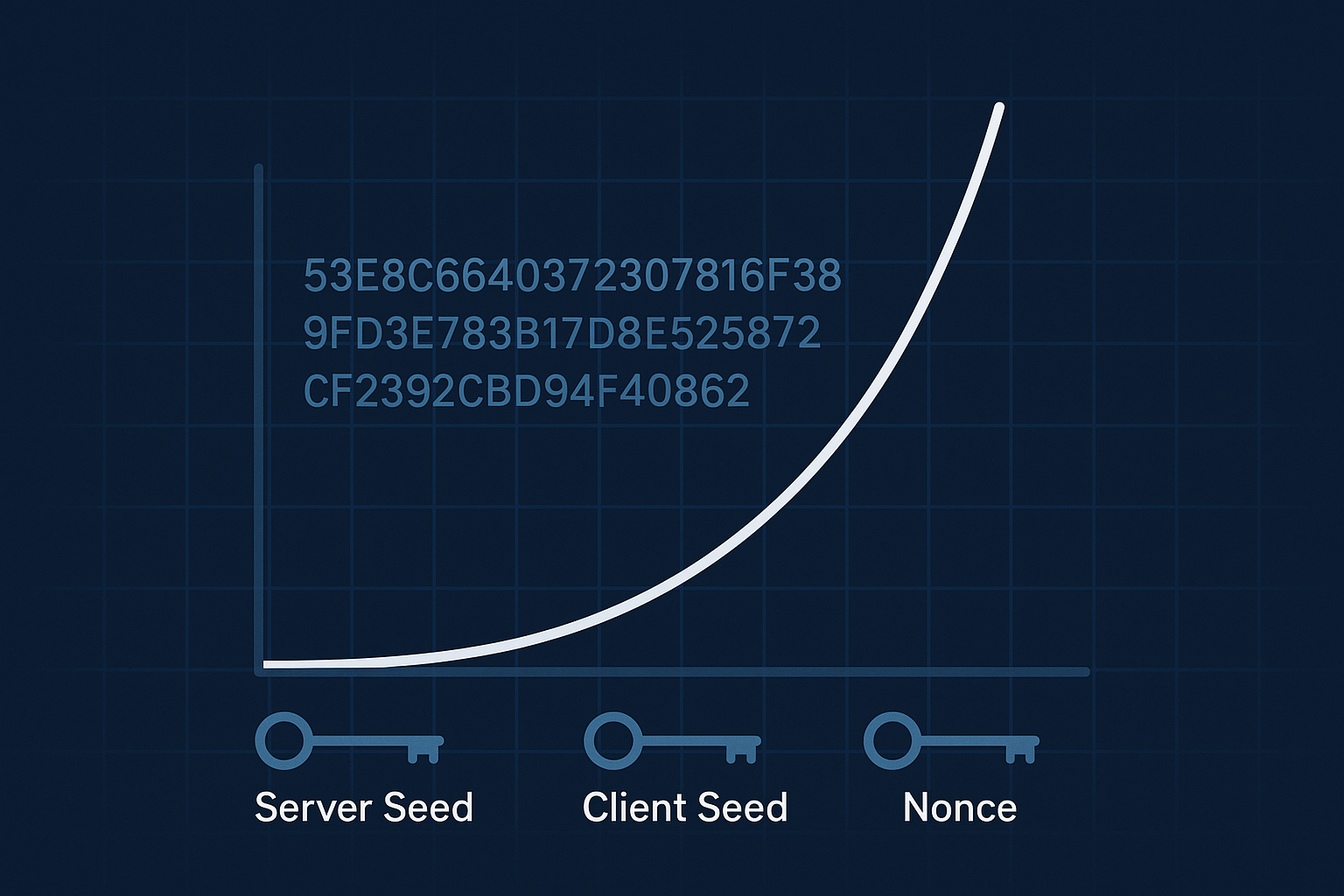
The three components: server seed, client seed, and nonce
Almost every provably fair system, whether it’s a crash game, dice, or a hash-based slot, is built from the same three inputs. Get comfortable with these and you can verify nearly any game you meet.
| Component | Who controls it | When you see it | Purpose |
|---|---|---|---|
| Server seed | The casino | Hashed before play, revealed after the seed is retired | Stops you from predicting the result |
| Client seed | You (or your browser) | Visible at all times, usually editable | Stops the casino from picking a result to suit itself |
| Nonce | The system | Visible in bet history | Makes every round with the same seed pair unique |
Server seed: the casino’s hidden number
The server seed is a long random string the operator generates and keeps secret while it’s in use. Before you bet, the site shows you a hash of it, a 64 character fingerprint that can’t be reversed. Think of it as a sealed envelope: you can see the seal, not the contents.
Once that seed is retired, usually when you click “rotate seed” or when the round series ends, the site publishes the raw seed. You hash it yourself. If your hash matches the fingerprint you were shown earlier, the seed inside the envelope was never swapped.
Client seed: your input in the process
The client seed is your contribution. On dice and similar games you can type in anything you like, a word, a random string, today’s cricket score. Because the final result depends on your seed too, the casino can’t sit on a pre-computed set of favourable outcomes and serve them to you. It genuinely doesn’t know what number you’ll enter.
Most sites fill this field automatically with a random value. Fine for convenience, but if you actually care about the proof, change it to something you chose. That single habit is what turns the client seed from decoration into protection.
Nonce: the round counter
The nonce is just a counter that starts at 0 or 1 and increases by one with every bet on the current seed pair. Same server seed plus same client seed plus nonce 47 always produces the same result, which is exactly why it’s verifiable. Without the nonce, every round on one seed pair would be identical.
In crash games with shared rounds, the counter often works at the round level rather than per player, because everyone at the table gets the same multiplier.
How provably fair hashing works
The three inputs are combined and run through a cryptographic hash function, almost always SHA-256, which is a public standard published by NIST. The output is a fixed length string of 64 hexadecimal characters. That string is then converted into a number and mapped onto the game’s outcome: a crash multiplier, a dice roll, a card, a set of reel positions.
Two properties make this work. First, hashing is deterministic. Feed in identical inputs and you get an identical output, every time, on any computer in the world. That’s what lets you reproduce the casino’s result at home. Second, it’s practically irreversible. Given only the output, there’s no shortcut back to the inputs, so publishing the hash of a server seed reveals nothing useful about the seed itself.
Most implementations use HMAC-SHA256 rather than plain SHA-256, with the server seed as the key and the client seed and nonce as the message. The mechanics are the same from a player’s point of view: same inputs in, same fingerprint out. What differs between casinos is the last step, how the resulting number is turned into a game result. That formula should be documented on the site’s fairness page. If it isn’t, that tells you something.
Step-by-step: how to verify any provably fair result
Verification is three moves: collect the values, run them through a calculator, compare. Here’s the practical version.
Finding your game’s seeds and nonce
- Open your bet history and select the round you want to check. Note the nonce or round ID.
- Copy the client seed used for that round. If you set it yourself, confirm it matches what you entered.
- Find the hashed server seed shown before play. Screenshot it if you’re being careful.
- Rotate or retire the seed pair to reveal the raw server seed. On sites with shared crash rounds, the seed is published automatically once the round series closes.
Using verification tools
- Use the casino’s own verifier first, normally under a link called Fairness, Provably Fair, or Verify. Paste in the server seed, client seed and nonce and it recalculates the outcome.
- Cross-check with an independent tool. Open source SHA-256 and HMAC calculators are widely available, and several community-built verifiers replicate the popular crash and dice formulas. A casino’s own verifier proving its own result is weaker evidence than an outside one.
- Separately, hash the revealed server seed on its own and compare it with the fingerprint you saved before betting.
What a successful verification looks like
Two matches, both exact. The hash of the revealed server seed equals the hash you were shown beforehand, character for character. And the outcome recalculated from the three inputs equals the result you actually got: the same 2.41× crash point, the same dice number, the same card.
A mismatch in either check is serious. Before assuming foul play, double-check for whitespace copied with the seed, the wrong nonce, or the wrong hash function, since these account for most failed verifications. If everything is clean and it still doesn’t match, raise a support ticket and keep your screenshots.
Provably fair in different game types
The verification skill transfers, because only the final conversion step changes.
| Game type | How the hash becomes a result |
|---|---|
| Crash / Aviator style | Hash converted to a number, then mapped to a multiplier curve that includes an instant-crash chance at 1.00× |
| Dice | Hash converted to a value in a fixed range, e.g. 0.00 to 99.99 |
| Mines / plinko | Hash used to shuffle tile positions or pick a drop path |
| Card games | Hash drives a deterministic shuffle of the 52 card deck |
| Hash-based slots | Hash bytes mapped to symbol positions on each reel |
Crash game fairness has one wrinkle worth knowing. Because every player in a round gets the same multiplier, some providers build the round result from the server seed combined with client seeds contributed by several players in that round, rather than one seed per player. Spribe’s Aviator works on that shared model. Our guide to Aviator’s provably fair system walks through that specific implementation in detail.
Note that most licensed slots from studios like Pragmatic Play or NetEnt are not provably fair. They use audited RNGs instead. That’s not a red flag, just a different trust model.
Limitations: what provably fair doesn’t guarantee
This is where a lot of crypto casino marketing overstates things. Provably fair verification proves one narrow thing: the outcome you received matches the committed inputs. It does not prove the game is generous, or the site is honest, or your money is safe.
- It doesn’t change the house edge. A verified crash round with a 1% house edge is still a 1% house edge. RTP is baked into the conversion formula, and verification confirms the formula ran correctly, not that the formula favours you.
- Seed selection can be gamed if commitment is weak. If a site reveals only one seed at a time and can generate a fresh one whenever it likes, it has room to choose seeds between rounds. Better implementations commit to a whole chain of hashed seeds in advance so nothing can be substituted mid-series.
- An auto-filled client seed weakens the proof. If the operator supplies both seeds, you’re back to trusting the operator.
- It says nothing about withdrawals. A site can run perfectly fair games and still stall your payout, void winnings on a technicality, or vanish. Licensing, ownership and payout history cover that, and provably fair does not.
- Bonuses aren’t verifiable. Wagering requirements, game weighting and max cashout caps sit entirely outside the cryptography.
- One verified round proves one round. Spot-checking a handful of results is sensible, but it isn’t a statistical audit of the game’s distribution.
Is provably fair actually trustworthy?
Yes for what it covers, when it’s properly implemented, and that caveat carries real weight. A provably fair game with a public algorithm, pre-committed seed chains, a player-editable client seed, and results you can reproduce in an independent calculator gives you a level of transparency no traditional RNG slot offers. You don’t have to believe anyone.
Implemented sloppily, it’s a badge on a homepage. Signs of a weak setup: no documented formula, no way to change your client seed, a server seed you can never get revealed, or a verifier that only works inside the casino’s own page. Any of those and you’re trusting the operator again, just with extra steps.
Treat it as one item on a longer checklist, alongside a real licence, a track record of paying out, and clear terms. On the payments side, our overview of crypto casinos for Indian players covers what to check before you deposit.
One last thing that verification can’t do: reduce your risk. Every one of these games has a mathematical edge in the house’s favour and a negative expected value over time, however cleanly the outcome hashes out. Set a deposit limit, treat what you spend as entertainment money, and use the responsible gambling tools your site offers if play stops feeling like a choice. Gambling is for adults, 18+ only.
FAQ
What does provably fair mean?
It means the casino publishes cryptographic proof, usually a hashed server seed, before your bet, then reveals the secret afterwards so you can recalculate the result yourself and confirm it wasn’t changed.
How do server and client seeds work?
The server seed is the casino’s secret input, committed in advance as a hash. The client seed is your input. Combining both means neither side can control the outcome alone, and the nonce makes each round in the series unique.
How do I verify a provably-fair result?
Collect the revealed server seed, your client seed and the nonce, run them through the casino’s verifier and an independent SHA-256 or HMAC calculator, then check that the recalculated result matches your round and that the revealed seed hashes to the fingerprint you saw before betting.
Is provably fair actually trustworthy?
For confirming individual game outcomes, yes, provided the algorithm is public, seeds are committed in advance and you can set your own client seed. It says nothing about whether the site pays out or how large the house edge is.