The Aviator provably fair system lets you check, after the fact, that the round you just played was not tampered with. It works by publishing a cryptographic fingerprint (a SHA-256 hash) of the server’s secret number before the round starts, then revealing the secret afterwards so you can hash it yourself and confirm nothing changed. Because your own client seed feeds into the same calculation, neither the game server nor the casino can pick a crash point that suits them.
That’s the whole idea in two sentences. Below is what each piece actually does, how to run the check yourself, and what provably fair does not promise (spoiler: it doesn’t remove the house edge).
What is provably fair gaming?
Provably fair is a cryptographic method that lets a player verify a specific round’s outcome was decided in advance and not altered. Instead of asking you to trust a certificate on a website, it hands you the raw numbers and the algorithm so you can reproduce the result yourself.
It exists because of a trust gap. Traditional online casino games run on an RNG (random number generator) that lives on the operator’s or provider’s server. You can’t see it. What you get instead is a lab certificate saying an auditor tested the RNG at some point in the past and it behaved randomly. That’s meaningful, but it’s a statement about the software in general, not about the round where your plane flew away at 1.02×.
Provably fair verification closes that gap for individual rounds. It doesn’t replace licensing or lab testing, it sits alongside them.
| Aspect | Certified RNG only | Provably fair |
|---|---|---|
| What’s verified | The RNG’s overall behaviour | Each individual round |
| Who verifies it | An independent testing lab | The lab, plus you |
| When | Periodically, during certification | Immediately after any round |
| Player input to the result | None | Yes, via your client seed |
| Tools needed | Trust in the certificate | Any SHA-256 calculator |
How Aviator’s provably fair system works
Three ingredients decide where the multiplier stops: a secret number from the server, one or more numbers from players’ browsers, and a hash function that mixes them into a single unpredictable output. Change any ingredient and the output changes completely.
The server seed (casino’s secret)
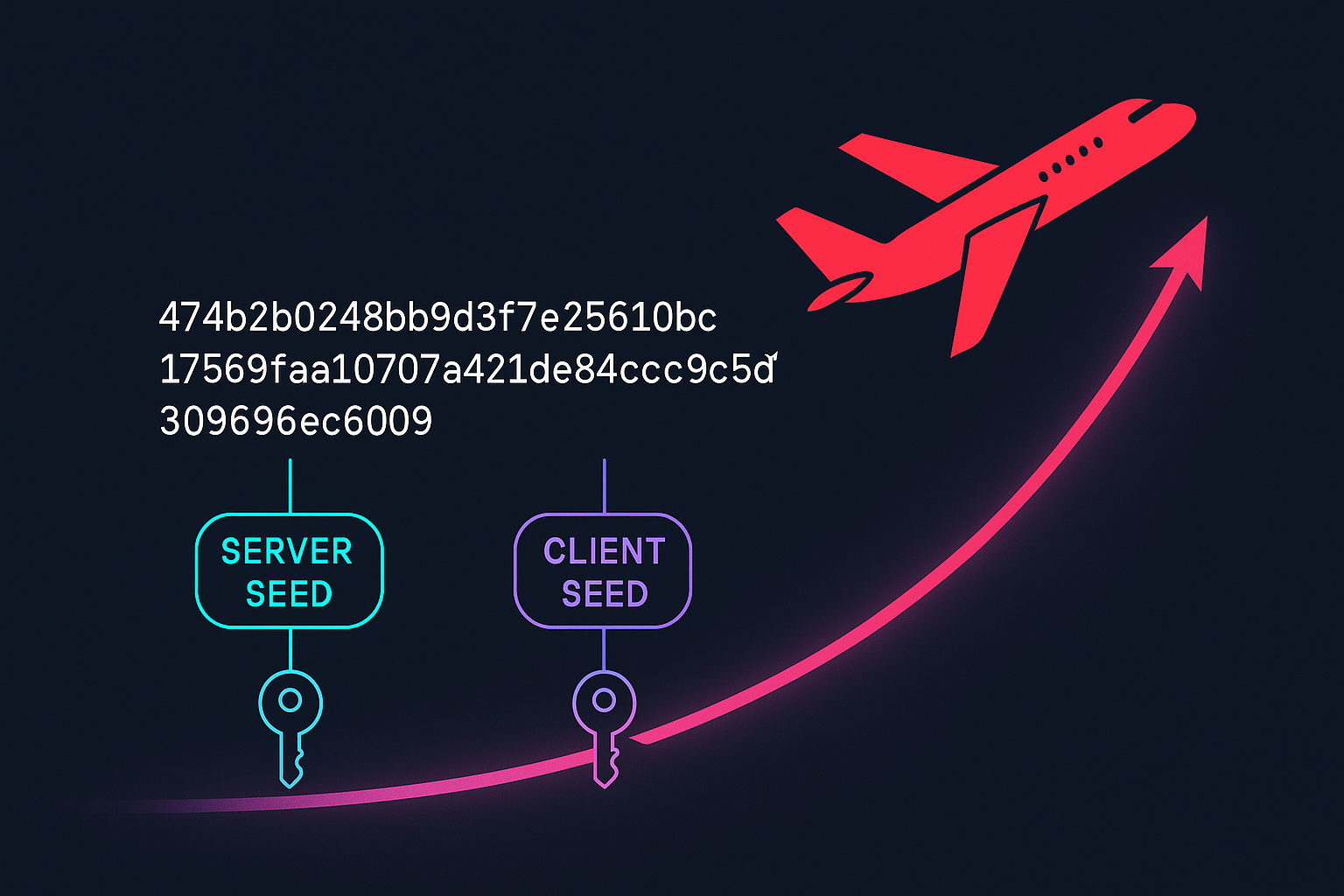
Before a round begins, the game server generates a random string, the Aviator server seed, and keeps it hidden. What it publishes immediately is the SHA-256 hash of that string, a 64-character fingerprint that looks like gibberish.
Think of it as sealing a written prediction in an envelope in front of you. The hash proves the envelope exists and that its contents are fixed. You can’t read the prediction from the hash, because SHA-256 only works one way: easy to compute forward, computationally infeasible to reverse. After the round, the server opens the envelope by revealing the seed, and you can hash it to confirm it matches the fingerprint published earlier. If the server had swapped the seed mid-round, the hashes would not match, and the swap would be obvious to anyone checking.
The client seed (your input)
The server seed alone would still leave the provider knowing the outcome in advance. That’s why Spribe’s implementation mixes in client seeds contributed by the players themselves, taken from the first bets placed in that round. Your browser supplies a random value, and you can change it manually in the game’s fairness settings.
This is the part most people skip, and it’s the part that matters most. Because the server commits to its seed before it knows what the client seeds will be, it cannot compute the crash point ahead of time. It’s a joint calculation with inputs from both sides.
The hash function (SHA-256 algorithm)
SHA-256 is a cryptographic hash function published by the US National Institute of Standards and Technology and used everywhere from TLS certificates to Bitcoin. Feed it any text and it returns a fixed 64-character hexadecimal string. Two properties make it useful here: the same input always gives the same output, and flipping a single character in the input scrambles the entire output.
Aviator concatenates the server seed with the client seeds, hashes the combined string with SHA-256, and converts part of the resulting hex value into a number, which the game’s published formula turns into the round’s crash multiplier. Same inputs, same multiplier, every time. That determinism is exactly what makes verification possible.
| Component | Who controls it | Published before round | Revealed after round |
|---|---|---|---|
| Server seed | Game server | Only as a SHA-256 hash | Yes, in full |
| Client seeds | Players’ browsers | Visible to their owners | Yes |
| Combined hash | Nobody, it’s derived | No | Yes |
| Crash multiplier | Derived from the hash | No | Yes |
Step-by-step: how to verify an Aviator round
You need about two minutes and a generic SHA-256 calculator. Use an independent one, not a tool hosted by the casino you’re checking, otherwise you’re back to trusting the same party.
- Open the fairness settings before you play. In the Aviator interface, the menu includes a provably fair section. Note the hashed server seed shown there for the upcoming round, and set your own client seed if you want to be certain your value is in the mix.
- Play the round and note the multiplier. Write down the crash point, for example 3.47×.
- Open the round in history. In the “My bets” or “All bets” list, each finished round has a fairness icon. Clicking it opens the round’s verification screen.
- Read the revealed values. You should see the plain server seed, the client seeds used, the combined hash, and the resulting multiplier.
- Check the commitment. Paste the revealed server seed into a SHA-256 calculator and compare the output to the hash that was published before the round. Character for character, it must match. If it does, the server did not change its number after seeing the bets.
- Check the result. Paste the combined string of server seed plus client seeds into the calculator and compare the output to the combined hash shown on the verification screen. Then apply the provider’s published conversion to confirm it produces the multiplier you saw. The in-game verification screen links to that algorithm, and third-party crash-game verifiers automate the same arithmetic.
If any step fails to reproduce, you have a concrete, checkable complaint rather than a hunch, which is worth far more when you contact support or a licensing body. In practice, a mismatch almost always means you copied a value with a stray space or verified the wrong round.
Why this proves Aviator isn’t rigged
The pre-commitment is what does the work. Once the hash of the server seed is published, the seed is locked. The server cannot wait to see that you staked ₹5,000 instead of ₹50 and then choose an early crash, because the only seed that will hash to the published fingerprint is the one it committed to. And it couldn’t have chosen a convenient outcome earlier either, since it didn’t yet know the client seeds that would be mixed in.
Two misconceptions are worth killing off:
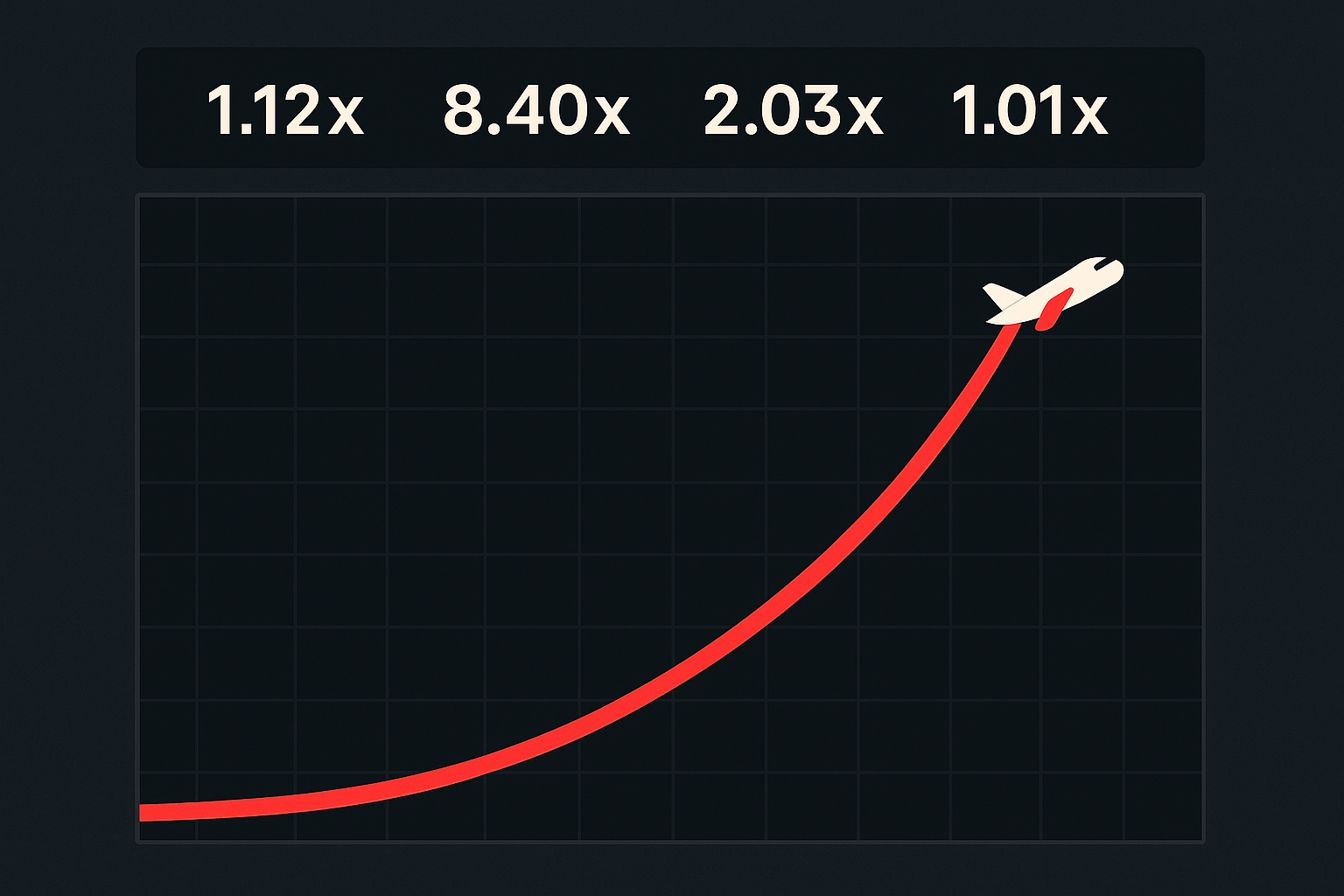
- “There’s a pattern in the multipliers.” Each round is an independent draw. A stretch of 1.0x–1.5x crashes followed by a 40× says nothing about the next round. Humans are very good at seeing structure in random sequences, which is why the gambler’s fallacy has survived so long.
- “The game targets big bets.” The crash point is fixed by the seeds before cash-outs happen. Your stake size is not an input to it.
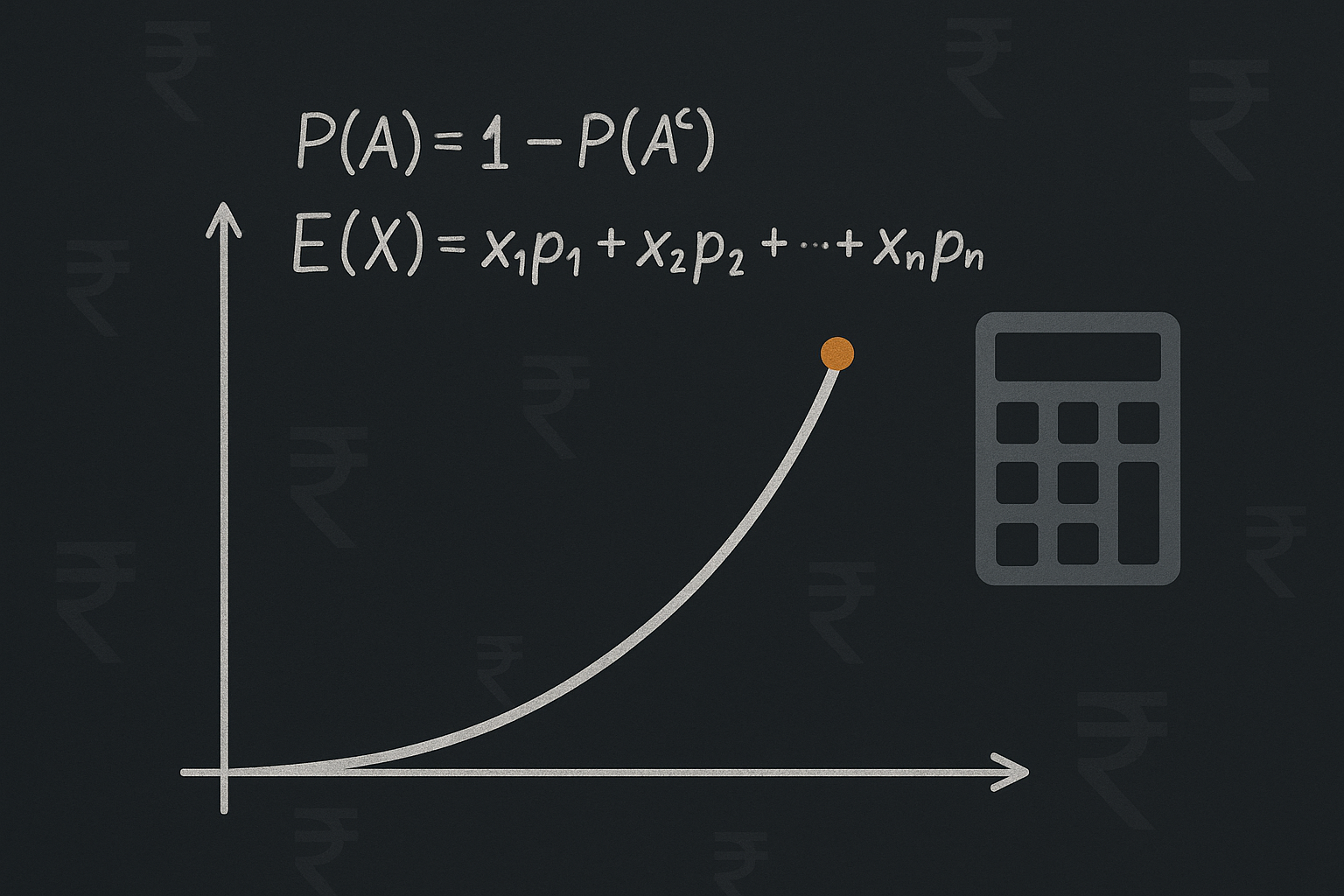
What provably fair does not do is change the maths. Aviator’s stated RTP is 97%, which means a 3% house edge: over the long run, the game returns about ₹97 per ₹100 wagered on average, and keeps roughly ₹3. That’s an average across millions of rounds, not a session promise. A verifiably fair game with a house edge is still a game with a house edge, and no cash-out pattern or “signal” service changes it. If you want the mechanics of stakes and auto cash-out explained honestly, see our Aviator game guide and our breakdown of Aviator betting approaches.
About Spribe: the company behind Aviator
Spribe is the B2B studio that developed Aviator, which launched in 2019 and became the template most later crash games copied. Spribe doesn’t run casinos; it licenses its games to operators, which is why you’ll find the same Aviator across dozens of very different sites.
Provably fair is part of that business model rather than a marketing extra. A supplier selling one game to many operators needs each operator’s players to trust that the operator can’t touch the results, and cryptographic verification is a cleaner argument than a promise. Spribe games are also supplied through licensed operators and tested by independent laboratories; for current licences and certificates, check Spribe’s own provider documentation and the licensing footer of the casino you play at.
One practical warning that matters more than any of the above: clone sites exist. Standalone “Aviator” apps and unlicensed sites sometimes run copied graphics over software with no verification screen at all. If you can’t open a fairness panel, see a hashed server seed, and change your client seed, you are not playing the Spribe game. Stick to licensed operators, and read our notes on how casino RNG certification works if you want the wider picture.
Frequently asked questions
Is the Aviator game rigged?
In the genuine Spribe version, you don’t have to take anyone’s word for it: verify a round yourself using the steps above. The pre-committed server seed hash makes after-the-fact manipulation detectable. The game is still built with a house edge of roughly 3%, so it is designed to be profitable for the operator over time, which is different from being rigged.
Can a casino still cheat if the game is provably fair?
Not on the round outcome, since the operator doesn’t generate it. Fairness of the maths and fairness of the business are separate questions, though. Slow payouts, harsh bonus wagering requirements, or blocked withdrawals have nothing to do with cryptography, which is why the operator’s licence and terms still deserve a read.
What if I never change my client seed?
Verification still works, because the seed used in the round is shown to you and included in the hash. Setting your own value simply removes any doubt about where the client seed came from. If you’re the type to double-check, change it.
Are there verification tools I can use?
Any general purpose SHA-256 calculator confirms that a revealed seed matches its published hash, and that’s the step that catches tampering. Several independent crash-game verifiers also reproduce the multiplier from the seeds. Prefer tools not operated by the casino whose round you’re checking.
How does provably fair work in Aviator without a blockchain?
No blockchain is needed. Blockchains use hashing for the same reason Aviator does, to make records tamper-evident, but the trick here is simply publishing a hash before the event and the input afterwards. Chain technology would add a public timestamp, not a different guarantee.
Verification tells you the round was honest. It doesn’t tell you the next multiplier, and nothing can. Set a deposit limit, treat what you stake as the cost of entertainment, and use the session and self-exclusion tools your operator provides if play stops feeling like play. Support is available in India through helplines and counselling services if gambling is affecting your finances or wellbeing.