Should you split 9s in blackjack? The quick answer
Yes, in most cases. Basic strategy says you should split 9s in blackjack against a dealer upcard of 2, 3, 4, 5, 6, 8 or 9. You stand on your 18 against a dealer 7, 10 (including jack, queen, king) or Ace.
That pattern looks odd at first. Why split against an 8 or 9 but stand against a 7 that sits between them? Because 18 is a genuinely strong hand against a dealer 7 and a mediocre one against an 8 or 9. The rest of this guide walks through the mechanics, the dealer-by-dealer math, and the mistakes that cost players the most money on this hand.
What does “splitting 9s” mean in blackjack?
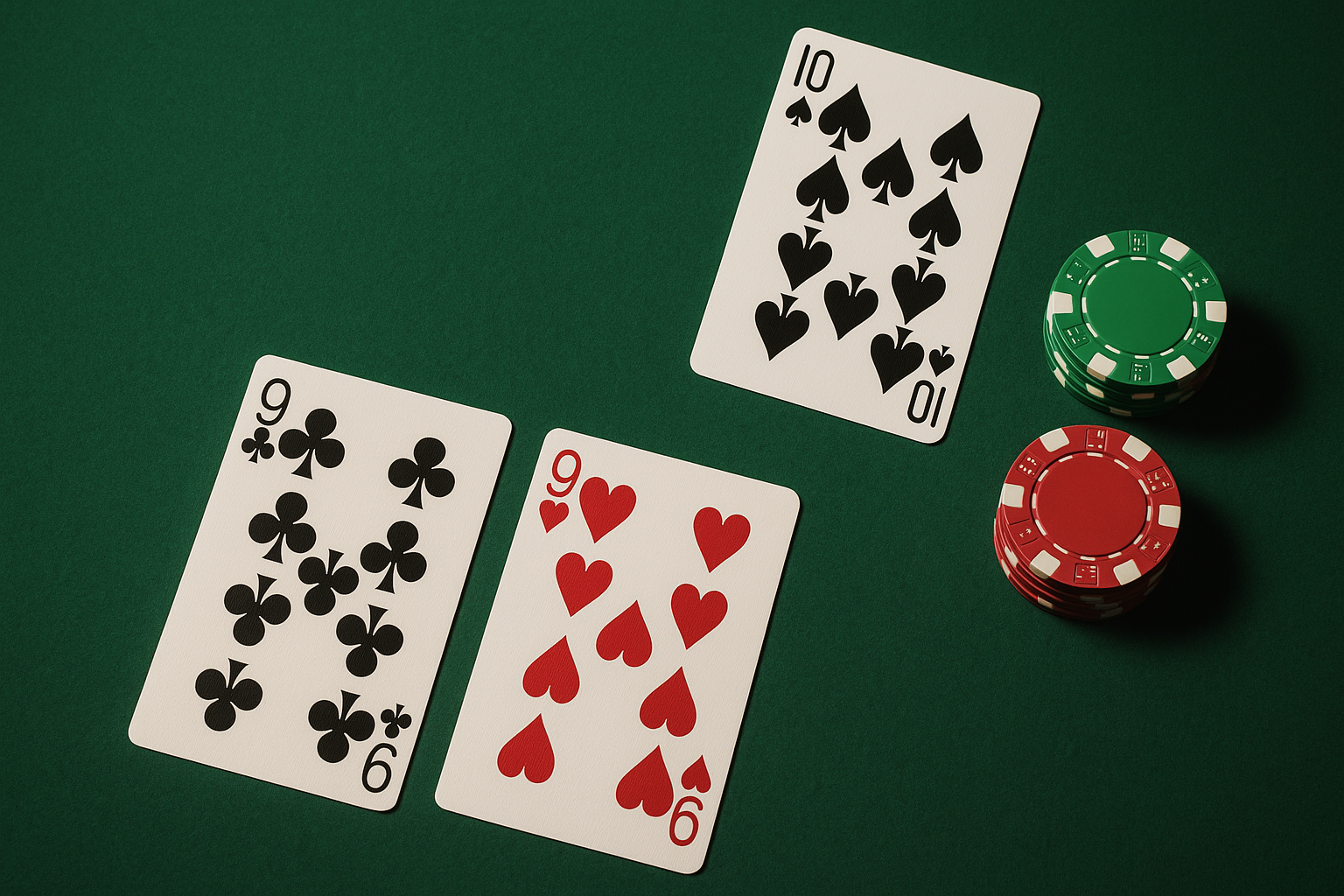
Pair splitting is the option to take two cards of the same rank, separate them into two hands, and place a second bet equal to your first. Each hand then receives one more card and is played independently.
Say you bet ₹100 and are dealt 9-9. Your options are:
- Stand on a hard total of 18 with your original ₹100 at risk.
- Split, adding ₹100 so you have ₹200 in action across two hands, each starting with a single 9.
- Hit — technically allowed, almost always wrong, since any card above a 3 busts you.
After splitting, each 9 gets a new card. Draw a 10 or face card and you have 19. Draw an Ace and you have a soft 20. Draw a low card and you may need to hit again, with the usual risk of busting. Most tables also allow doubling after a split (DAS) and re-splitting if you catch a third 9, though house rules vary. Read the table rules before you sit down, because those two rules shift a handful of marginal decisions.
The important thing to understand is what splitting actually costs. You are giving up a made 18 and doubling your money to build two new hands. That trade only makes sense when the dealer’s upcard makes 18 a weak holding, or when it makes both new hands likely winners.
When to split 9s: complete dealer upcard breakdown
Here is the full decision chart for a pair of 9s against every dealer upcard, with the dealer’s approximate bust probability in a standard multi-deck game where the dealer stands on soft 17. Bust figures are rounded.
| Dealer upcard | Correct play with 9-9 | Approx. dealer bust chance | Why |
|---|---|---|---|
| 2 | Split | ~35% | Weak dealer; two 9s outperform one 18 |
| 3 | Split | ~37% | Same logic, slightly weaker dealer |
| 4 | Split | ~40% | High bust rate rewards extra money in play |
| 5 | Split | ~42% | Dealer’s worst position |
| 6 | Split | ~42% | Dealer’s worst position |
| 7 | Stand | ~26% | Dealer’s likeliest total is 17; your 18 beats it |
| 8 | Split | ~24% | 18 only pushes against dealer 18; splitting aims for 19+ |
| 9 | Split | ~23% | Dealer 19 beats your 18; splitting reduces the loss |
| 10, J, Q, K | Stand | ~21% | Strong dealer; don’t double your exposure |
| Ace | Stand | ~17% | Strongest upcard; limit the damage |
Against weak dealer cards (2-6): always split
With a 2 through 6 showing, the dealer must draw and busts often, roughly a third to over 40% of the time depending on the card. Your 18 would already win most of those hands, but so would two hands starting from a 9. Splitting puts a second bet into a spot where the dealer is most likely to self-destruct. You are not trying to make 20; you are getting more money on the table while the dealer is at their weakest.
Against dealer 7: always stand
This is the exception people forget. A 7 upcard most commonly finishes as 17, because any of the four 10-value ranks in the hole makes exactly 17. Your hard 18 beats 17. Splitting throws away a favourite hand and replaces it with two hands that each need to draw a 10 or Ace just to get back ahead. Take the 18 and move on.
Against dealer 8-9: split again
Against an 8, an 18 is heading for a push more often than a win, since the dealer’s most likely total is 18. Against a 9, the likely dealer total is 19, which beats you outright. A pushing or losing hand is worth giving up. Each split 9 has a reasonable chance of becoming 19, 20 or 21, and even the hands that end up at 18 or below aren’t much worse off than the 18 you started with. This is where splitting turns a poor situation into a playable one.
Against strong cards (10, Ace): stand
With a 10 or Ace showing, the dealer is in command and busts least often. Splitting here means doubling your bet into two hands that are both underdogs. Standing on 18 keeps your loss to one bet and still wins whenever the dealer busts or ends on 17. Note that the standard chart above assumes the dealer stands on soft 17; some rule variants shift a couple of borderline decisions, so use a strategy chart that matches the table you’re actually playing.
The basic strategy logic behind splitting 9s
Blackjack basic strategy is not a system for beating the house. It’s a set of decisions that produce the highest expected value for each combination of your cards and the dealer’s upcard, calculated from the full deck composition. Expected value here means the average result of a decision if you made it thousands of times.
Every 9-9 decision comes down to comparing two expected values: the EV of standing on hard 18, and the combined EV of two hands that each start with a 9 and carry a full bet.
Standing on 18 has a positive expected value against 2 through 8. It’s a decent hand. But “decent hand” and “best decision” aren’t the same thing. Against a 5 or 6, splitting has an even higher expected value, so you take it. Against a 7, standing wins that comparison because 18 is already ahead of the dealer’s most likely total. Against a 9, standing on 18 has a negative expectation, and splitting loses less on average, so splitting wins by being the smaller loss. Against a 10 or Ace both options are negative, and standing is the less costly one.
That’s the whole framework: sometimes you split to win more, sometimes you split to lose less, and sometimes you refuse to split because your hard total is already the favourite. Bust probability and the dealer’s most likely final total drive every one of those calls. If you want the fundamentals behind this, our blackjack basics and strategy guide covers hard totals, soft totals and doubling down in more depth.
Common mistakes when playing pocket 9s
Knowing when to split in blackjack is one thing; doing it under pressure with real money is another. These four errors show up constantly at live dealer tables.
- Splitting against a dealer 7. Players see 9-9 and split on autopilot. Against a 7, you’re breaking up the one hand that’s already a clear favourite. This is the single most expensive 9-9 mistake.
- Refusing to split against 8 or 9. An 18 feels safe, so players stand and hope. Against a dealer 9 that hand is losing money on average. Splitting doesn’t feel comfortable, but the math is clear.
- Splitting against a 10 or Ace. Usually driven by frustration after a losing streak. You’re doubling your stake against the dealer’s strongest cards, which is the opposite of what the numbers support.
- Hitting the 18. Rare, but it happens. Only a 2 or 3 improves a hard 18 without busting it, so hitting turns a good hand into a likely loss.
One more habit worth breaking: changing your decision because of what happened on the last hand. Cards are dealt from a shuffled deck or shoe, and previous rounds don’t change the correct play. Online blackjack uses an RNG (or a real shuffled shoe in live dealer games), and neither has any memory of your last three losses.
How correct splitting affects your blackjack results
Blackjack has one of the lowest house edges on the casino floor, but only for players who follow the chart. Gambling math resources including the Wizard of Odds put the house edge for a basic-strategy player in a typical multi-deck game at roughly 0.5%, depending on the exact rules (number of decks, whether the dealer hits soft 17, whether doubling after splitting is allowed, and the blackjack payout). Playing by instinct instead pushes that edge up substantially, commonly into the 1.5-2%+ range for an average recreational player. Publisher note: attach the current cited figure and source link for the basic-strategy and average-player house edge before publishing.
Put that in rupee terms. At ₹500 a hand and roughly 80 hands an hour, you’re wagering about ₹40,000 an hour in total action. A 0.5% edge represents an average theoretical loss of about ₹200 over that hour; a 2% edge represents about ₹800. Same game, same stakes, four times the expected cost, purely from decision quality.
Pair splitting decisions on their own account for a small slice of that gap, since 9-9 comes up on a minority of hands. But the point is that the leaks add up. Getting 9s right is one of the cheapest corrections available: it’s a single memorised rule with one exception.
None of this makes blackjack profitable. Correct basic strategy shrinks the house edge, it does not remove it, and over time the house still wins. Treat the money you play with as entertainment spend, set deposit and loss limits before you start, and use the cool-off or self-exclusion tools your operator offers if play stops being fun. If gambling is causing you problems, seek support from a professional helpline or counselling service.
Frequently asked questions
When should you not split 9s?
Don’t split 9s against a dealer 7, 10, jack, queen, king or Ace. Against a 7 your 18 is already better than the dealer’s most likely total of 17. Against a 10 or Ace the dealer is too strong to justify doubling your bet, so standing limits the loss.
How does the dealer’s upcard affect the decision?
The upcard determines both the dealer’s bust probability and their most likely final total. Weak cards (2-6) bust often, so more money in play is good. A 7 usually makes 17, which your 18 beats. An 8 or 9 usually makes 18 or 19, which your 18 pushes or loses to, so splitting becomes the better play.
What does basic strategy say about pairs generally?
Always split Aces and 8s. Never split 10s or 5s. Everything else, including 9s, depends on the dealer’s upcard. Splitting 4s, 6s and low pairs is often tied to whether doubling after splitting is allowed at your table.