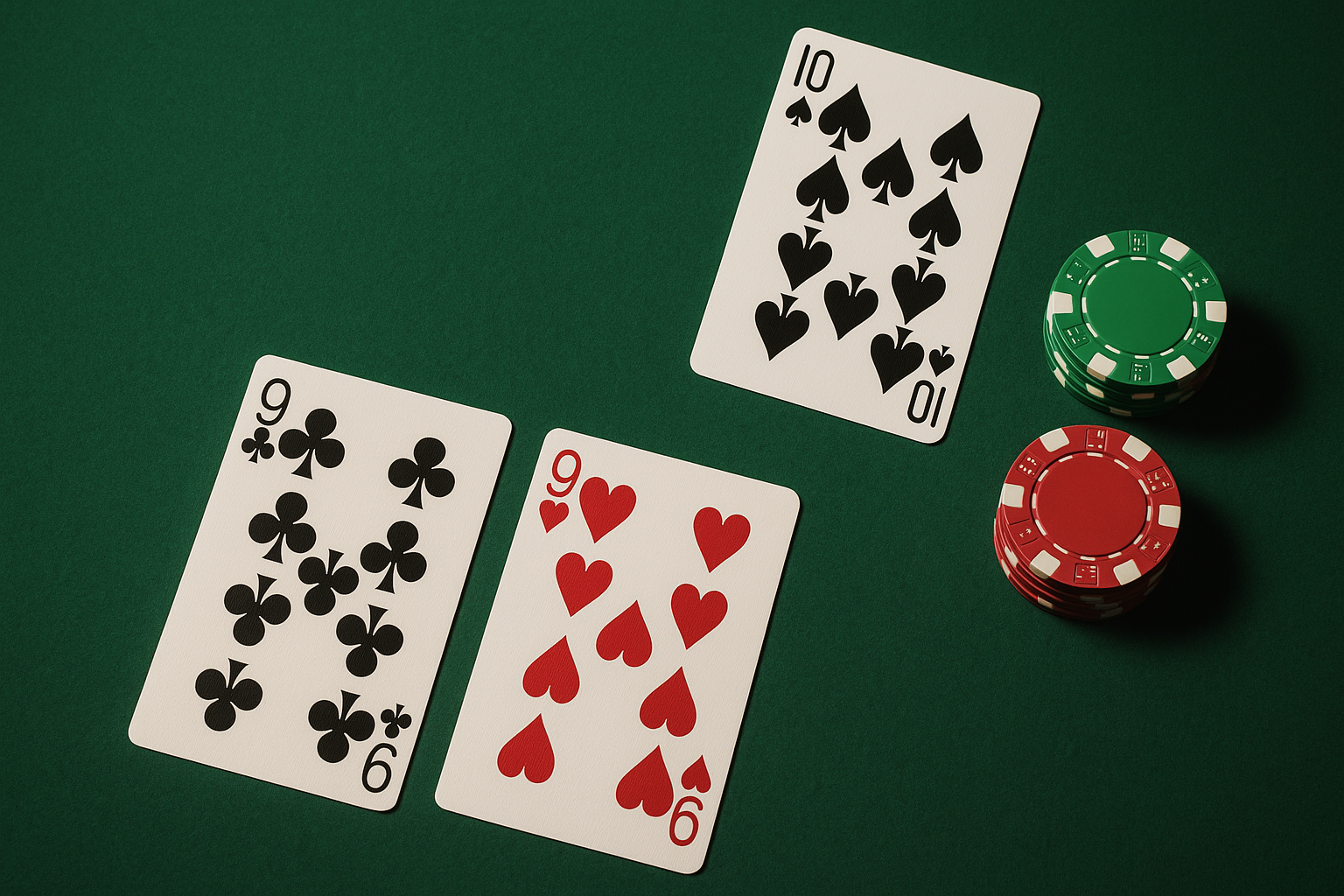
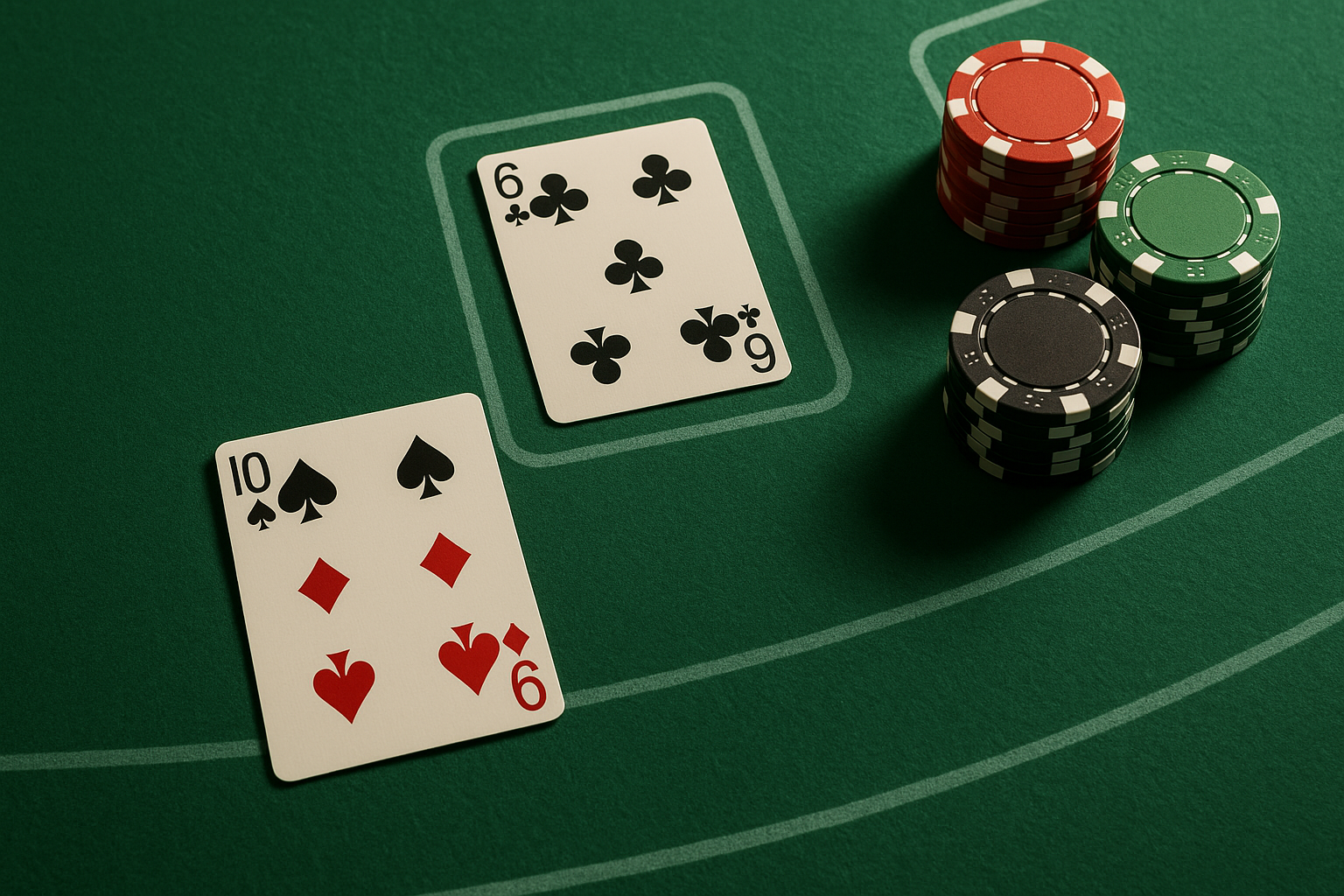
What is a stiff hand in blackjack?
A stiff hand in blackjack is a hard total of 12 through 16: too high to draw safely, too low to expect a win by standing. That’s the whole problem in one sentence. Any card of 6 or higher can bust a 16, yet standing on 16 leaves you beaten by every dealer total from 17 to 21.
The word “hard” matters here. A hard total contains no ace, or contains an ace that must count as 1 because counting it as 11 would push you over 21. Soft hands are different animals entirely, and they get played differently.
Examples of stiff hands
- 10 + 6 = hard 16
- 9 + 4 = hard 13
- 7 + 5 = hard 12
- 8 + 7 = hard 15
- Ace + 4 + 9 = hard 14 (the ace is forced to count as 1)
- 5 + 4 + 5 = hard 14
Hard 17 and above is not stiff, because basic strategy says stand every time. Hard 11 and below is not stiff either, since you can’t bust with one card. The trouble lives entirely between those two zones.
Stiff vs soft hands (quick comparison)
The same numeric total plays completely differently depending on whether it’s hard or soft, because a soft hand can absorb a big card without busting.
| Hand | Total | Can one card bust it? |
|---|---|---|
| 10 + 6 | Hard 16 | Yes, any 6 through 10 busts it |
| Ace + 5 | Soft 16 | No, the ace drops to 1 |
| 9 + 4 | Hard 13 | Yes, any 9 or 10-value card busts it |
| Ace + 2 | Soft 13 | No |
That’s why soft 16 is a routine hit and hard 16 is the hand players agonise over.
The hard 12 to 16 problem: why these hands are tricky
Hard 12 to 16 are the worst hands in the game because both options are bad. Hit and you risk busting immediately, losing your bet before the dealer even draws. Stand and you’re relying on the dealer to bust, since your total loses to any dealer 17 through 21.
Basic strategy doesn’t find a good answer for these hands. It finds the less bad one. Over the long run, hard 12 to 16 are losing hands regardless of how well you play them, which is a large part of why blackjack has a house edge at all.
Bust probability by hand total
Here’s the chance of going over 21 on the very next card, based on a full shoe with no other cards removed. This is a simple count of which ranks kill the hand.
| Hard total | Cards that bust you | Bust chance on one hit |
|---|---|---|
| 11 or less | None | 0% |
| 12 | 10, J, Q, K | ~31% |
| 13 | 9 and 10-value cards | ~38% |
| 14 | 8, 9 and 10-value cards | ~46% |
| 15 | 7 through 10-value cards | ~54% |
| 16 | 6 through 10-value cards | ~62% |
| 17 | 5 through 10-value cards | ~69% |
Notice how quickly it climbs. Hitting 12 busts you less than a third of the time; hitting 16 busts you nearly two thirds of the time. That gradient is exactly why 12 and 16 get played differently against the same dealer card.
Why you can’t avoid these situations
You can’t. Stiff hands are dealt constantly, and you have no say in it. Roughly a third of two-card starting hands land in the 12 to 16 range, and you also fall into it by drawing, for example hitting a hard 8 and catching a 5. Every session includes plenty of them, so learning the correct plays pays off more than avoiding the hands ever could, because avoiding them isn’t an option.
When to hit or stand: basic strategy for stiff hands
The rule is simpler than most beginners expect. Against a dealer 2 through 6, stand on 13 to 16 (and on 12 against 4, 5 or 6). Against a dealer 7 through Ace, hit every stiff hand. Hard 12 versus a dealer 2 or 3 is the one exception that trips people up: hit it.
Strategy chart: 12-16 vs dealer upcard
This chart assumes standard multi-deck rules where the dealer stands on soft 17, and no surrender. H = hit, S = stand.
| Your hand | 2 | 3 | 4 | 5 | 6 | 7 | 8 | 9 | 10 | A |
|---|---|---|---|---|---|---|---|---|---|---|
| Hard 12 | H | H | S | S | S | H | H | H | H | H |
| Hard 13 | S | S | S | S | S | H | H | H | H | H |
| Hard 14 | S | S | S | S | S | H | H | H | H | H |
| Hard 15 | S | S | S | S | S | H | H | H | H | H |
| Hard 16 | S | S | S | S | S | H | H | H | H | H |
Two footnotes worth knowing. If your 16 is a pair of 8s, split it instead of standing or hitting. And if the table offers late surrender, surrendering hard 16 against a dealer 10 (and 15 against a 10) is the correct play, because giving up half your bet loses less than playing the hand out.
The dealer bust factor
Standing on 14 feels passive, and it is. You aren’t trying to make a good hand, you’re transferring the risk of busting to the dealer, who must keep drawing until reaching at least 17. When the dealer’s upcard is small, that forced-draw rule works against them, so the smart move is to stay out of the way. When the upcard is big, the dealer will usually make a standing total, and your 14 loses by default unless you improve it.
Dealer bust probability: the key to your decision
Dealer bust rates by upcard are the reason the chart splits neatly at 7. Approximate figures for a multi-deck game where the dealer stands on soft 17:
| Dealer upcard | Dealer bust chance | What it means for a stiff hand |
|---|---|---|
| 2 | ~35% | Stand 13-16, hit 12 |
| 3 | ~38% | Stand 13-16, hit 12 |
| 4 | ~40% | Stand 12-16 |
| 5 | ~43% | Stand 12-16 |
| 6 | ~42% | Stand 12-16 |
| 7 | ~26% | Hit |
| 8 | ~24% | Hit |
| 9 | ~23% | Hit |
| 10 | ~21% | Hit |
| Ace | ~12% | Hit |
The gap between a dealer 6 (busts roughly 42% of the time) and a dealer 7 (roughly 26%) is huge, and it flips your decision entirely. Against a 6, standing on 16 wins about four times in ten without you risking a thing. Against a 10, standing on 16 wins only when the dealer busts, which is about one time in five, so taking a 62% bust risk to improve is still the better of two poor choices.
Hard 12 versus a dealer 2 or 3 is the borderline case. Your bust risk on one card is only about 31%, and the dealer’s bust rate at 35 to 38% isn’t high enough to make standing on a 12 worth it. The margin is thin, but hitting wins slightly more over thousands of hands.
Common mistakes with stiff hands (and how to avoid them)
Almost every basic strategy error involving stiff hands comes from one of these habits.
- Hitting 16 against a dealer 5 or 6. You bust 62% of the time to escape a hand that already wins over 40% of the time by doing nothing.
- Standing on 12 against a dealer 2 or 3. Understandable instinct, wrong answer. Hit it.
- Ignoring the dealer’s upcard. The upcard is the single most important piece of information on the table. A hand played without looking at it is a coin flip on strategy.
- Treating soft 16 like hard 16. Ace-5 cannot bust on one card. Hit it and stop overthinking.
- Copying the player next to you. Other players’ decisions don’t change your expected value, and their reasoning is usually worse than the chart.
The “never bust” fallacy
Some players refuse to hit any total of 12 or more, on the theory that the dealer might bust anyway. It’s a comfortable idea and an expensive one. The dealer busts around 28 to 29% of hands overall, meaning you lose roughly seven times out of ten by standing pat on stiff hands against strong upcards. Never busting doesn’t protect your money, it just changes how you lose it.
When gut feeling beats math (spoiler: never)
Blackjack outcomes come from a shuffled deck, and in online games from a certified RNG or a real dealer shoe streamed live. Neither cares that you’ve lost four hands in a row or that a 5 “feels due”. Cards already dealt affect the composition of the remaining shoe, which is what card counting tracks, but that’s a disciplined mathematical technique, not intuition, and it doesn’t apply at all in games with continuous shuffling or in most online blackjack.
Playing basic strategy perfectly gets the house edge down to roughly half a percent under favourable rules. Playing on hunches can push it several percent higher. Even played perfectly, the edge stays with the house, which is the honest reality of every casino game.
Practice tips for playing stiff hands
- Learn the split at 7. Dealer 2-6 means stand your stiff hands, dealer 7-A means hit. Get that one rule automatic and you’ve covered the vast majority of stiff-hand decisions.
- Memorise the two exceptions. Hard 12 versus 2 and hard 12 versus 3 are hits. That’s it, everything else follows the split above.
- Drill with a chart open. Play low-stake or demo blackjack with the chart on screen and check every stiff hand against it before you act. Speed comes after accuracy.
- Say the reason out loud. “Dealer has 5, he busts more than 40% of the time, I stand.” Attaching a reason to each play makes it stick far better than rote memorisation.
- Judge yourself on decisions, not results. You will stand on 15 against a 6 and watch the dealer make 20. The play was still correct. Over the long run only the decision quality is under your control.
- Check the table rules first. Whether the dealer hits or stands on soft 17, and whether surrender is available, changes a few borderline plays.
If you’re still getting comfortable with the basics of hitting, standing, splitting and doubling, start with our blackjack rules and basics guide, then come back to this chart. When you want to drill the plays for real money at small stakes, our casino reviews cover which sites offer live and RNG blackjack tables to Indian players, along with their limits and payment options.
One last thing. Correct strategy reduces the house edge, it doesn’t remove it, and no chart turns blackjack into income. Set a deposit or loss limit before you sit down, treat the money as entertainment spend, and use the cool-off or self-exclusion tools every licensed site provides if play stops being fun. Gambling is for adults aged 18 and over only.
FAQ
What is a stiff hand in blackjack?
A hard total of 12 to 16, containing no usable ace. It’s called stiff because you can bust by hitting it, yet it loses to every dealer total from 17 to 21 if you stand.
How do you play a hard 12 to 16?
Stand against a dealer upcard of 2 through 6, with one exception: hit hard 12 against a dealer 2 or 3. Hit all stiff hands against a dealer 7, 8, 9, 10 or Ace.
When should you hit a stiff hand?
Whenever the dealer shows 7 through Ace, because the dealer busts only about 12 to 26% of the time with those cards and will usually finish with 17 or better.
Why are stiff hands hard to play?
Because both choices lose money in the long run. Hitting hard 16 busts you about 62% of the time, and standing on it wins only if the dealer busts. Basic strategy picks the smaller loss, not a winner.