Online betting regulation in India has never been settled, and 2024-25 made it messier rather than clearer. Gambling is a state subject under the Constitution, so 28 states and 8 union territories each write their own rules. On top of that sit central tax rules (28% GST on deposits, 30% TDS on net winnings), IT rules that let the government block websites, and, in August 2025, a new central law aimed at banning online money games outright.
This is a plain-English explainer of where things stand and what it means in practice. It is general information, not legal advice. If your situation involves real money or a specific state’s law, talk to a lawyer who handles gaming matters.
Is online betting legal in India? The current legal framework
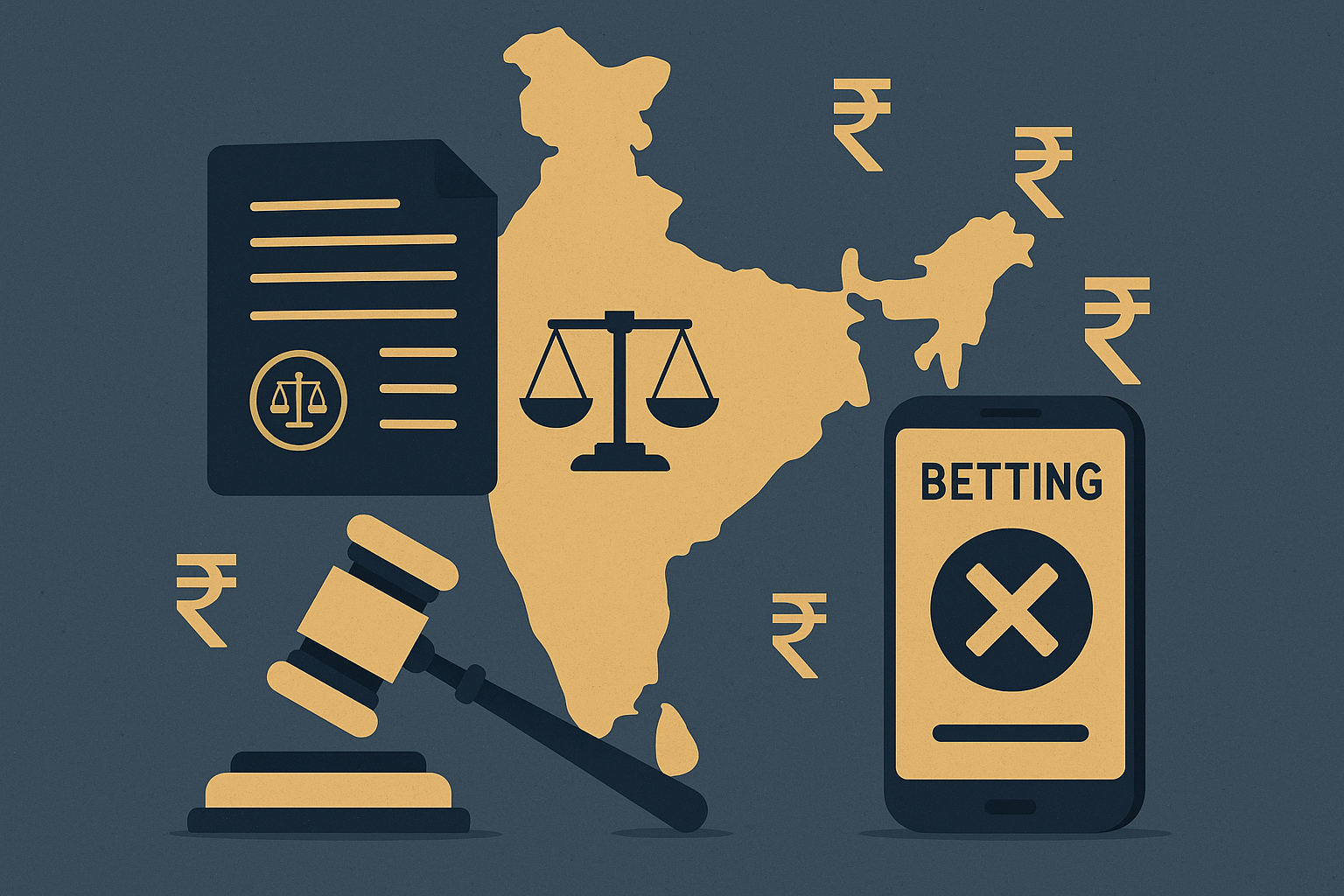
There is no single yes or no. Under Entry 34 of the State List in the Seventh Schedule of the Constitution, “betting and gambling” is a state legislative subject, so legality depends on where you are. Most state laws ban games of chance played for stakes but carve out games of skill. Central law then layers tax and internet-blocking powers on top, and the Promotion and Regulation of Online Gaming Act, 2025 moves toward a nationwide prohibition on online money games.
Central laws vs state authority
The oldest piece of the puzzle is the Public Gambling Act, 1867. It criminalises running or visiting a “common gaming house” and was written for physical premises with cards and dice. It says nothing about servers, apps or offshore websites, which is exactly why the online question stayed unresolved for so long. Several states adopted or adapted it; others, like Tamil Nadu, Telangana and Assam, passed their own gaming statutes.
The central government’s real leverage over the online market has come from three directions. First, the Information Technology Act, 2000, whose Section 69A allows blocking of websites. Second, the IT (Intermediary Guidelines) Amendment Rules of April 2023, which created a category of “online real money game” and a self-regulatory body mechanism that was never actually operationalised, while barring games involving wagering on outcomes. Third, tax law, which turned out to be the most effective tool of all.
The 2025 Act changes the framing. As passed, it promotes e-sports and online social games while prohibiting online money gaming, its advertising, and the processing of payments for it. Penal provisions are directed at operators, advertisers and payment facilitators rather than individual players. Rules, notifications and court challenges were still working their way through the system, so check the current position with primary sources such as the Ministry of Electronics and Information Technology before relying on any summary, including this one.
The “skill game” exception
Indian courts have long distinguished games where skill predominates from games where chance does. In State of Andhra Pradesh v. K. Satyanarayana (1968) the Supreme Court treated rummy as a game of skill. In K.R. Lakshmanan v. State of Tamil Nadu (1996) it held horse racing to be a game of skill rather than gambling. That distinction is why fantasy sports, rummy and poker platforms operated openly for years while sports betting and casino games did not.
Two things to understand about the exception. It has always been contested state by state, with courts in Karnataka and Kerala striking down blanket online bans while Tamil Nadu, Telangana and Andhra Pradesh pushed the other way. And it never covered casino games, slots, crash games like Aviator, or bookmaker-style sports betting. A roulette wheel or an RNG-driven slot is chance by definition, whatever the marketing says.
State-by-state online gambling rules: where you can and can’t bet
Broadly, three groups exist: states with a licensing framework, states with explicit prohibitions, and the large silent majority whose old gambling acts predate the internet. The table below summarises the main positions reported through 2024-25. Treat it as orientation, not a legal opinion, because amendments and litigation change details frequently.
| State / UT | Position on online real money play | Main instrument |
|---|---|---|
| Sikkim | Licensed, but online play restricted to intranet terminals within the state | Sikkim Online Gaming (Regulation) Act, 2008 |
| Nagaland | Licences issued for listed games of skill | Nagaland Prohibition of Gambling and Promotion and Regulation of Online Games of Skill Act, 2016 |
| Goa, Daman | Land-based casinos permitted in five-star hotels and offshore vessels; no online licensing regime | Goa, Daman and Diu Public Gambling Act, 1976 |
| Tamil Nadu | Prohibitionist, with online gaming legislation and regulator; scope of the ban litigated in the Madras High Court and appealed further | Tamil Nadu Prohibition of Online Gambling and Regulation of Online Games Act, 2022 |
| Telangana | Explicit ban on online games played for stakes, including skill games | Telangana Gaming Act as amended (2017) |
| Andhra Pradesh | Explicit ban on online gaming for money | AP Gaming (Amendment) Act, 2020 |
| Assam, Odisha | Long-standing broad prohibitions covering skill games played for money | Assam Game and Betting Act, 1970; Odisha Prevention of Gambling Act, 1955 |
| Karnataka, Kerala | Attempted online bans struck down by the respective High Courts; position remains contested | State amendments / notifications, 2021 |
| Most other states | Silent on online play; older acts target physical gaming houses | Public Gambling Act, 1867 and state adaptations |
States that allow online betting
Only Sikkim and Nagaland built actual licensing regimes, and both are narrow. Sikkim’s licences were designed for intranet gaming inside the state, not a nationwide online market. Nagaland licenses specified games of skill and expects operators to keep chance-based products out. Goa’s framework is about physical casino floors, not websites.
States with explicit bans
Telangana, Andhra Pradesh, Assam and Odisha have the clearest prohibitions, and they extend to skill games played for money. Tamil Nadu joined them with its 2022 Act, which also set up a state gaming authority and imposed player-protection conditions such as identity verification and restricted playing hours. If you live in these states, the law does not treat online real money play as a gray area.
Gray area states
Everywhere else, the old statutes simply do not mention the internet. That silence, plus the skill-game case law, is what offshore operators leaned on when they advertised to Indian users. The 2025 central Act narrows that space considerably, since a national prohibition on online money gaming does not depend on what a state’s 19th century law says.
GST and tax rules on online gaming: what players pay in 2024-25
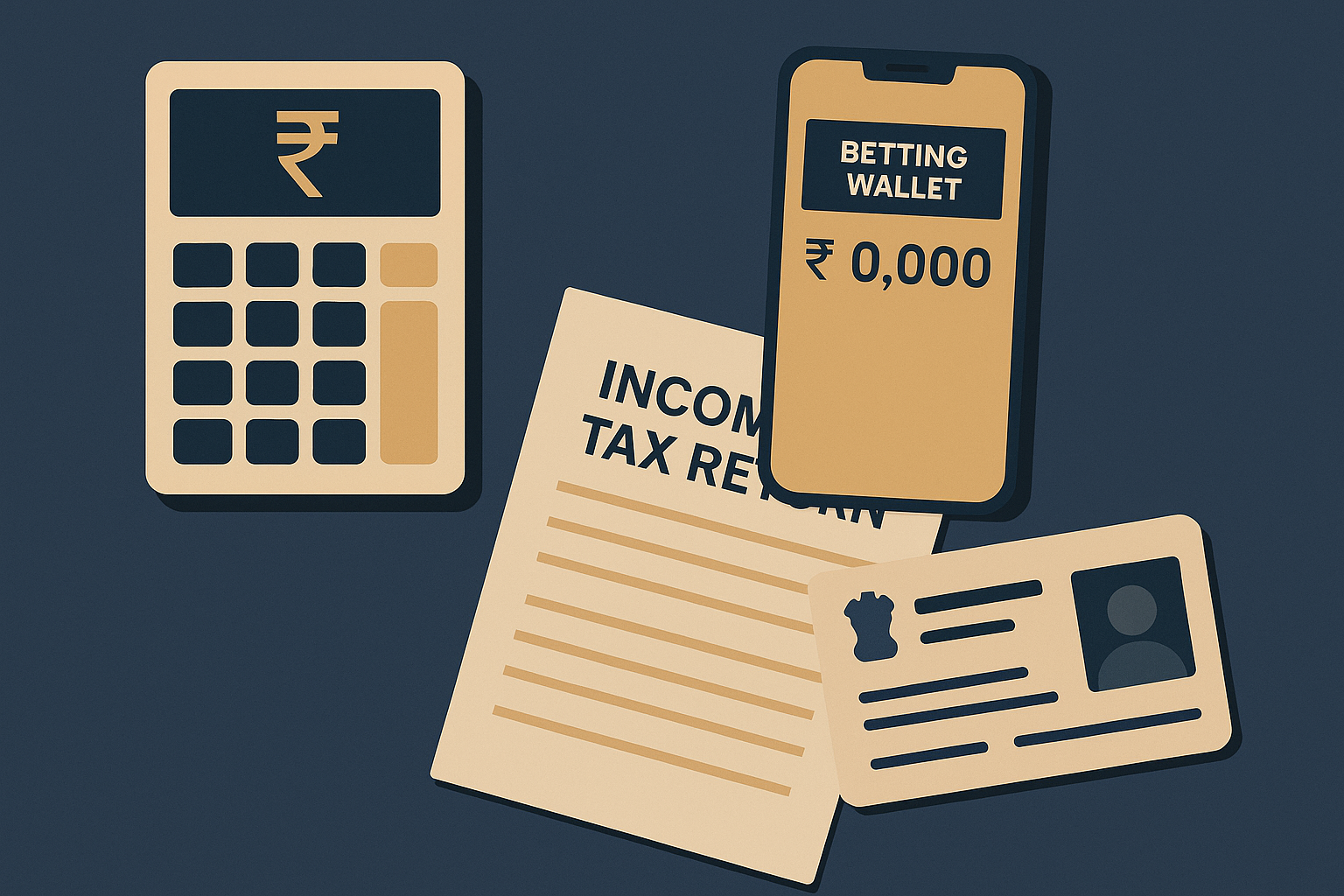
Tax is the part of online betting regulation in India that hits your balance directly, and it applies regardless of the legality debate. Two separate charges exist: 28% GST on what you deposit, and 30% income tax with TDS on your net winnings.
28% GST on deposits explained
Following GST Council decisions and the amendments effective 1 October 2023, online money gaming is taxed at 28% on the full amount deposited with the platform, not on the operator’s commission and not on your winnings. The valuation rule looks at the total amount paid in by the player.
In practice you see one of two treatments. If GST is charged on top, a ₹1,000 playable balance costs you ₹1,280. If your ₹1,000 payment is treated as inclusive, roughly ₹781 reaches your balance and about ₹219 goes to tax. Either way the money is gone before your first spin or bet, and a 28% entry cost is far larger than the house edge on most games, which for a 96% RTP slot is 4%.
Tax on winnings and TDS
Section 115BBJ of the Income-tax Act taxes net winnings from online games at 30%, plus applicable surcharge and cess. Section 194BA requires 30% TDS on net winnings, calculated at the time of withdrawal and again at the end of the financial year. There is no small-amount threshold the way there is under Section 194B for lottery and traditional betting winnings.
Three details that catch people out: you cannot deduct expenses, you cannot set gaming losses off against other income, and the basic exemption limit does not shelter this income. Offshore sites usually do not deduct TDS at all, which does not remove your liability to declare and pay tax on winnings.
What this means for your bankroll
A simple worked example, ignoring surcharge and cess:
| Item | Amount |
|---|---|
| Total deposits in the year | ₹10,000 |
| GST at 28% (charged on deposits) | ₹2,800 |
| Total withdrawals | ₹25,000 |
| Net winnings (withdrawals − deposits) | ₹15,000 |
| TDS at 30% on net winnings | ₹4,500 |
| Cash position after tax | ₹7,700 |
The point is not that winning is impossible; it is that the tax layer sits on top of a house edge that already makes the long-run expected return negative. Every game has a built-in mathematical advantage for the operator, and no staking pattern removes it.
How to tell if a betting site is legal for Indian players
Blunt answer: no website can be “licensed in India” for casino games or sports betting, because no central or state authority issues that kind of licence to a nationwide online operator. What you can check is whether a site is licensed somewhere, transparent about it, and compliant with the rules that apply to you. For broader context on how licensing works, see our overview of what you need to know about casino regulation.
Licensing and jurisdiction checks
- Look in the site footer for a named regulator and licence number, then verify it on the regulator’s own register. Common jurisdictions include Curaçao, Malta and the Isle of Man.
- Understand what the licence buys you: audited RNGs, published RTP, complaint procedures in that jurisdiction. It does not make the site lawful in India, and Indian courts are not an easy route to enforce an offshore dispute.
- Check the terms for restricted territories. Some operators exclude specific Indian states.
- Confirm the site states an 18+ (or higher, where applicable) minimum age and enforces KYC before payouts.
Payment method compliance
Payments are where regulation bites first. Banks and payment aggregators have blocked transactions linked to betting, UPI collections get shut down, and the RBI’s Liberalised Remittance Scheme does not permit remittances for lottery tickets and sweepstakes. If a site routes deposits through unrelated merchant names, crypto only, or constantly changing third-party processors, that is a compliance signal about the site, and a practical risk for you if a withdrawal stalls. Our guide to payment methods for Indian players covers how these rails behave in practice.
Red flags of unlicensed sites
- No licence details, or a licence “seal” image that links nowhere.
- No KYC, no deposit limits, no self-exclusion or cool-off tools.
- Bonus terms that hide wagering requirements, or a headline offer with a 60× rollover and a low max cashout.
- Domain names that change every few weeks, or clone sites with near-identical branding.
- Marketing that implies betting is a way to make money, or that dodges age warnings.
Recent enforcement and what it means for players
Enforcement through 2024-25 targeted the supply side, not individual punters. The government has issued blocking orders against large numbers of offshore betting and gambling URLs under Section 69A of the IT Act, the Enforcement Directorate has pursued offshore betting operations under money-laundering and foreign exchange law, and the Ministry of Information and Broadcasting has repeatedly advised broadcasters, publishers and OTT platforms to stop carrying betting advertisements and surrogate ads for “news” and “opinion” sites. Tax authorities separately raised very large retrospective GST demands on gaming companies, litigation that reached the Supreme Court.
The 2025 Act consolidates that pressure by prohibiting online money games, their advertising and payments made for them. For players, the practical consequences are the ones you can already see: sites disappearing behind ISP blocks, apps vanishing from stores, deposits failing without explanation, mirror domains appearing, and withdrawals becoming harder to complete when a payment channel is cut mid-process. Money sitting in an account on a blocked or shuttered platform is the single biggest risk, and it is not covered by any Indian consumer protection scheme.
None of this is a reason to panic or a green light. It is a reason to read the current law for your state, keep records of deposits and withdrawals for tax purposes, and treat any balance held offshore as money you may not get back.
FAQ
Is online betting legal in India?
There is no simple yes. States regulate betting and gambling, so it depends on your state, and Telangana, Andhra Pradesh, Tamil Nadu, Assam and Odisha have explicit prohibitions on online play for money. Central law also moved toward a national ban on online money games with the Promotion and Regulation of Online Gaming Act, 2025. Verify the current position before acting.
Which states allow online gambling?
Only Sikkim and Nagaland created licensing frameworks, and both are limited, Sikkim to intranet gaming within the state and Nagaland to listed games of skill. Goa permits land-based casinos, not online operators. Most other states have older laws that never addressed the internet.
How much tax do I pay on betting winnings?
Net winnings from online games are taxed at 30% under Section 115BBJ, with 30% TDS under Section 194BA at withdrawal and at financial year end, plus applicable surcharge and cess. Separately, 28% GST applies to deposits made to online money gaming platforms. Losses cannot be set off against other income.
How do I tell if a betting site is legal?
Check for a named regulator and licence number you can verify on the regulator’s register, clear terms including restricted territories, enforced KYC and age checks, and working responsible gambling tools. Remember that an offshore licence is not Indian authorisation and gives you limited recourse here.
A note on playing responsibly
Every casino game and sportsbook market carries a house edge, which means the expected return over time is negative, and the Indian tax layer makes that worse. Betting is entertainment with a cost, not income. Set deposit and loss limits before you play, use cool-off or self-exclusion tools if play stops feeling optional, and never stake money you need. Only adults who meet the legal age requirement should gamble. If it is becoming a problem, see our responsible gambling resources for help lines and self-help tools.
This article summarises publicly reported law and policy as of 2024-25 for general information. It is not legal or tax advice, and the rules cited here can change through amendment, notification or court order.